

 Tiếng Việt
What is a Rubber Conveyor? Detailed Structure of Rubber Conveyors
Have you ever wondered how products can move continuously and precisely on giant production lines? The secret lies in a device that seems simple but is extremely important: rubber conveyors. With a special structure and many outstanding advantages, rubber conveyors have become an indispensable link in most modern industries.
What is a Rubber Conveyor?
A rubber conveyor is a system with a large load capacity, composed of thick rubber layers. Rubber conveyors are used for the purpose of automatically transporting materials from one point to another without human intervention. Like the blood vessel of a factory, rubber conveyors ensure the continuous flow of products.
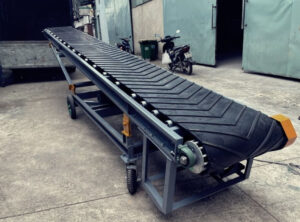
The standout feature of rubber conveyors is sustainability, with the ability to withstand abrasion and impact. At the same time, with bulky and large volumes of goods, rubber conveyors can transport them easily. This is an essential and reliable companion for many companies. Currently, there are many different conveyors to choose from and apply effectively to each industry.
You may be interested in: What is a conveyor? Benefits of using conveyors
Structural Characteristics of Rubber Conveyor Belts
Rubber conveyors are an indispensable device in many industries, from manufacturing and food processing to logistics. The structure of a rubber conveyor includes many important parts working together to transport goods efficiently.
Conveyor Frame
It is the main load-bearing part, usually made of galvanized steel or stainless steel to ensure durability and corrosion resistance. The frame design can be box-shaped or trapezoidal, depending on the load and size of the conveyor.
Conveyor Belt
The conveyor belt is used to transport materials, made from layers of rubber and fabric plies. The rubber surface layer is in direct contact with the goods, often having cleats to increase friction. The fabric ply layer provides tensile strength. Usually, the thickness of the conveyor belt has different structures depending on the transport needs.
Rubber Surface Layer
The rubber surface layer is in direct contact with the materials to be transported. The rubber layer has a thickness from 3 to 6mm with high durability. Depending on the usage needs, people can choose a smooth or cleated form.
Intermediate Rubber Layer
The intermediate rubber part has the effect of reducing noise and vibration during transport. At the same time, it also increases the adhesion between the fabric ply and the rubber surface.
In addition to the three rubber layers above, rubber conveyors can have many other layers such as cushions or steel cores. Depending on usage needs, operators can add other layers.
Roller System

The roller system is an indispensable component of rubber conveyors. Rollers are arranged according to a certain axis to help guide goods. The traction of the motor is distributed evenly on the rollers and reduces the load on them.
Fabric Ply Layer
The fabric ply layer is an important component of the rubber conveyor system. The fabric ply acts as the backbone, providing strength, rigidity, and load-bearing capacity.
The fabric ply is usually made from synthetic fibers such as nylon or polyester. The fabric ply is woven into layers and pressed tightly into the rubber layer of the conveyor. Each fabric ply layer has fibers running in different directions to create a solid network.
Roller System
The roller system is an indispensable component in rubber conveyors. Rollers help reduce friction between the conveyor belt and the goods, helping it operate smoothly and durably. Rollers are arranged according to a specific axis. From there, they direct the goods to move in a straight line or curve.
Drive Pulley and Idler Pulley
The idler pulley plays the role of guiding and supporting, helping the conveyor belt transmit along the correct trajectory. The drive pulley acts as the driving power source for the conveyor.
Tensioning Device
In rubber conveyors, the tensioning device plays an important role in maintaining the necessary tension for the belt. From there, it ensures the conveyor operates stably and extends the system’s life.
Gear Motor
The gear motor provides the necessary energy to pull the conveyor belt to move, transporting goods from one point to another. The reducer helps reduce the rotational speed of the motor and increases torque. From there, it drives the conveyor into motion.
Controller
The controller is a device or software used to monitor and adjust conveyor operations. Currently, two popular controllers are inverters and switches. Choosing and installing the appropriate controller will optimize the production process and costs.
Vertical conveyor – a solution for transporting goods vertically
Advantages of Industrial Rubber Conveyors
Rubber conveyors bring many benefits to the production process. Outstanding advantages when using rubber conveyors can be mentioned as:
- Efficiency Enhancement: Helps transport goods continuously with hand pallet trucks quickly, minimizing downtime.
- Productivity Increase: Automates the transport process, minimizing manual labor.
- Safety Assurance: Minimizes the risk of occupational accidents due to manual lifting and lowering of goods.
- Flexibility: Can be designed to suit many types of goods and different spaces.
- Durability: Rubber material and solid structure help the conveyor have a high lifespan.
- Cost Saving: Reduces labor and maintenance costs, and increases equipment lifespan.
- Environmental Protection: Minimizes noise pollution and dust.
What Factors Affect Rubber Conveyor Prices?
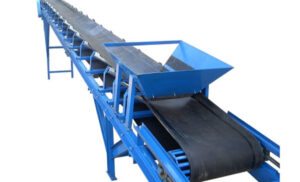
If you intend to buy a rubber conveyor, you need to care about the following factors because they affect the price:
- Material: The type of rubber used and the thickness of the rubber layer directly affect the cost. Natural rubber usually has a higher price than synthetic rubber and higher durability as well.
- Size: The larger the length, width, and thickness of the conveyor, the higher the cost.
- Structure: Number of fabric plies, type of splice, auxiliary parts such as rollers, conveyor frame…
- Special Features: Conveyors with special features such as heat resistance, chemical resistance, and anti-static usually have a higher cost.
- Manufacturer: The brand and reputation of the manufacturer also affect the cost. Big brands usually have higher prices due to better quality and warranty services.
- Quantity: Buying in large quantities usually enjoys preferential prices.
- Technical Requirements: Requirements such as high precision and load-bearing capacity will increase the cost.
Conclusion
Rubber conveyors are indispensable devices in modern industries. With the ability to transport diverse goods efficiently, rubber conveyors have become the optimal solution for various applications. Hopefully, with the information shared by Naltako, it has helped you understand more about rubber conveyors and related information. If you need advice on lifting equipment to help improve production efficiency, please contact:
CONTACT INFORMATION
Website: naltako.vn
Hotline: 0981.977.898
Email: nhat.mtk53@gmail.com
Workshop Address: Km19, Highway 6, Phuc Tien Ward, Bien Giang, Ha Dong, Hanoi
Representative Office Address: 4th Floor, SME Royal Building, To Hieu, Ha Dong, Hanoi
Nội dung có liên quan:
-
 Quality Car Wash Lift Supplier – Naltako
In modern life, owning a car has become more popular than ever. Car wash lifts have emerged as an optimal solution, making the vehicle cleaning process fas...
Quality Car Wash Lift Supplier – Naltako
In modern life, owning a car has become more popular than ever. Car wash lifts have emerged as an optimal solution, making the vehicle cleaning process fas...
-
 What is a Plastic Roller Conveyor? Advantages of Use
Plastic conveyor rollers are an indispensable component in modern conveyor systems. With advantages such as durability, lightweight, and variety in size, p...
What is a Plastic Roller Conveyor? Advantages of Use
Plastic conveyor rollers are an indispensable component in modern conveyor systems. With advantages such as durability, lightweight, and variety in size, p...
-
 Naltako – A Reputable Supplier of Affordable 2-Post Car Lifts
Are you looking for high-quality automotive lifting equipment at an affordable price? Cheap 2-post car lifts with modern designs, stable operation, and ver...
Naltako – A Reputable Supplier of Affordable 2-Post Car Lifts
Are you looking for high-quality automotive lifting equipment at an affordable price? Cheap 2-post car lifts with modern designs, stable operation, and ver...
-
 Fabric Reinforced Rubber Conveyor Belts: Advantages and Applications
Fabric reinforced rubber conveyor belts are a modern solution that meets the increasing demand for efficiency and optimization. With a unique structure com...
Fabric Reinforced Rubber Conveyor Belts: Advantages and Applications
Fabric reinforced rubber conveyor belts are a modern solution that meets the increasing demand for efficiency and optimization. With a unique structure com...
-
 Everything You Need to Know About Warehousing Services
Effective management and storage of goods are key factors for a business's success. Warehousing services have emerged as an optimal solution, helping busin...
Everything You Need to Know About Warehousing Services
Effective management and storage of goods are key factors for a business's success. Warehousing services have emerged as an optimal solution, helping busin...
-
 What is a 3-ton Mini Crane? Structure and Applications
The 3-ton mini crane, with its compact design and flexible operation, is increasingly becoming an indispensable tool in many fields. Notably, its compact s...
What is a 3-ton Mini Crane? Structure and Applications
The 3-ton mini crane, with its compact design and flexible operation, is increasingly becoming an indispensable tool in many fields. Notably, its compact s...
-
 Applications of Diesel Hand Pumps
In addition to convenience and efficiency, diesel hand pumps offer many outstanding advantages, making them a top choice in many applications. The oil hand...
Applications of Diesel Hand Pumps
In addition to convenience and efficiency, diesel hand pumps offer many outstanding advantages, making them a top choice in many applications. The oil hand...
-
 Export Plastic Pallets: A Guide to Effective Selection and Usage
Superior Advantages of Export Plastic Pallets over Wooden Pallets
In the field of goods export and international shipping, choosing the right type of pall...
Export Plastic Pallets: A Guide to Effective Selection and Usage
Superior Advantages of Export Plastic Pallets over Wooden Pallets
In the field of goods export and international shipping, choosing the right type of pall...