

 Tiếng Việt
Hydraulic Pump Symbols: Overview & Detailed Classification
Have you ever looked at a hydraulic schematic and felt overwhelmed by strange symbols? Especially the symbol for the hydraulic pump – the component considered the heart of the system?
Don’t worry anymore! This article will help you answer those questions.
Overview of Hydraulic Pump Symbols
Hydraulic pump symbols are standardized to represent hydraulic pumps in a hydraulic system schematic. They play a vital role in communicating information about the pump type, function, and characteristics in a concise and easy-to-understand manner.
Understanding hydraulic pump symbols is key to production, installation, operation, maintenance, and repair of hydraulic systems.
Production and Installation: Symbols provide information on pump type, flow rate, and working pressure, helping manufacturers select the pump that matches the system’s requirements. Additionally, relying on the hydraulic pump symbol helps installation technicians place the pump in the correct position and flow direction, ensuring the system operates efficiently.
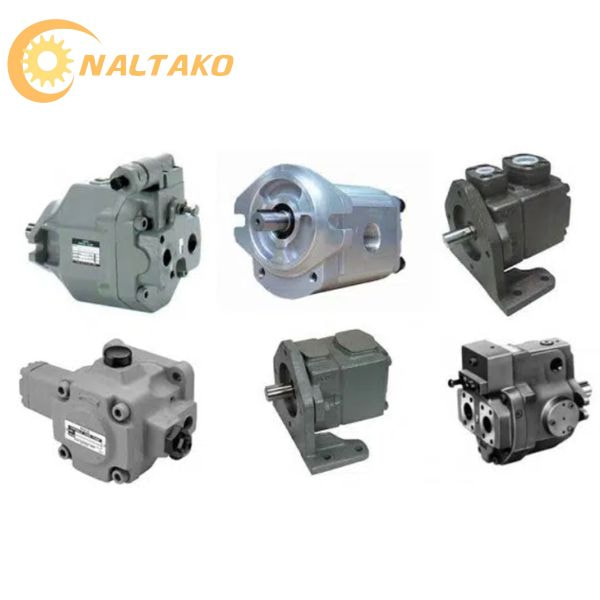
Operation: Through universally standardized symbols, operators can clearly understand the functions and capabilities of the pump within the system, allowing them to operate the system within safe limits and avoid damage.
Maintenance and Repair: When a system encounters a problem, pump symbols help technicians quickly identify the cause and isolate the area needing inspection and repair. The symbols provide accurate information about the model and pump type, making it easier for technicians to find suitable replacement parts.
In maintenance, symbols provide info regarding the type of hydraulic oil, pressure, and flow rate, helping technicians plan periodic maintenance for the pump and the system.
Basic Components of a Hydraulic Pump Symbol
A general hydraulic pump symbol is a circle with a black triangle pointing outward. However, to better understand this symbol, we need to analyze its constituent components.
Based on the general representation, we can see that this hydraulic pump symbol includes the following basic components:
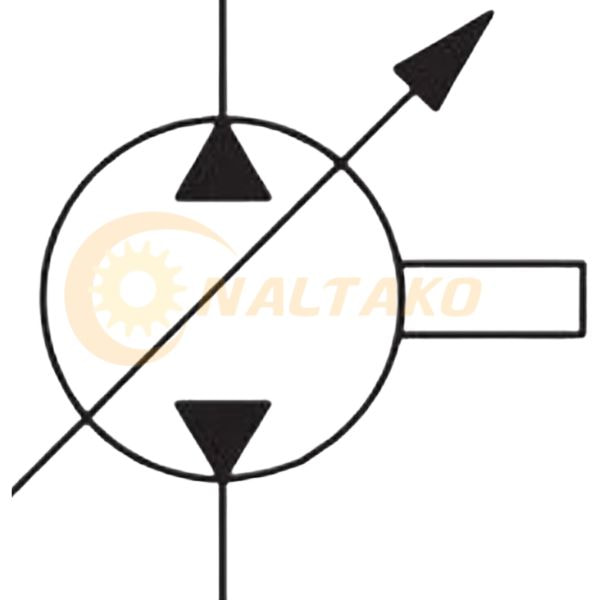
Circle: Represents the pump body.
Black Triangle: The black triangle indicates it is a hydraulic pump, and the arrow of the triangle indicates the flow direction of the hydraulic oil. In this case, oil is being pumped out of the pump.
Vertical Lines: Represent the pump’s inlet and outlet ports. The top line is the inlet, where hydraulic oil is drawn into the pump. The bottom line is the outlet, where hydraulic oil is pumped out.
Small Rectangle: Represents the position of the pump shaft.
Note: This symbol may have additional notations to indicate specific pump characteristics, such as:
- Variable: A diagonal arrow across the symbol indicates that the pump has an adjustable flow rate.
- Pressure Compensated: A diamond symbol inside the circle indicates the pump has a pressure compensation function.
- Pump Type: There may be additional symbols inside the circle to distinguish different pump types (gear, vane, piston).
Symbols for Other Types of Hydraulic Pumps
Hydraulic Gear Pump Symbols
There are two main types of hydraulic gear pumps, including:
External Gear Pump:
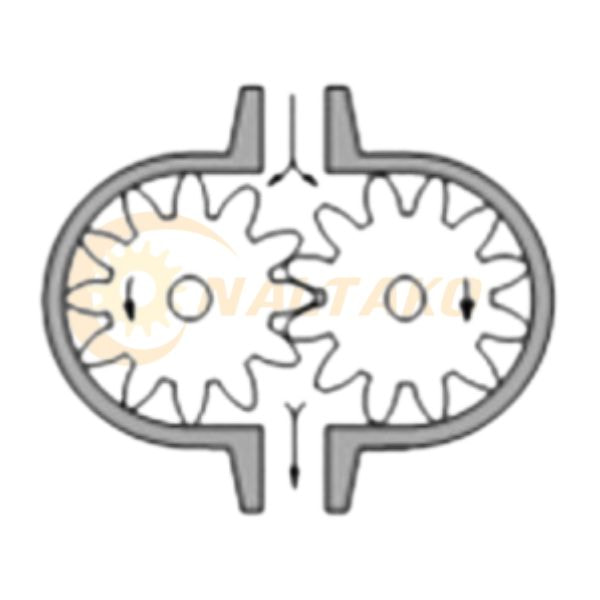
Symbol: Two identical gears meshing with each other. Arrows indicate the direction of oil entering and leaving the pump.
Reference Parameters:
- Rotational speed: 500 – 3500 rpm.
- Displacement (flow rate): 1.2 – 250 cm³.
- Working pressure: 63 – 160 bar.
- Efficiency: 80% – 91%.
Advantages: Simple construction, low cost, easy to maintain.
Disadvantages: Higher noise levels compared to internal gear pumps, lower efficiency at high pressures.
Internal Gear Pump:
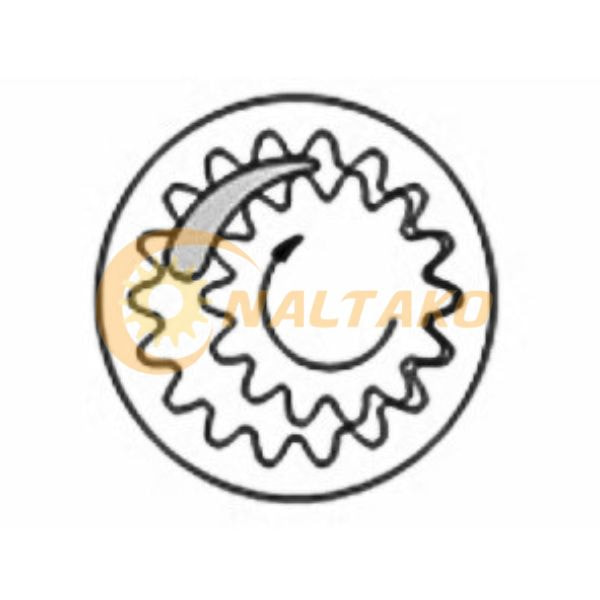
Symbol: A smaller gear located inside a larger ring gear. Arrows indicate oil direction and a crescent shape represents the internal gear spacing.
Technical Reference Parameters:
- Rotational speed: 500 – 3500 rpm.
- Displacement (flow rate): 4 – 250 cm³.
- Working pressure: 160 – 250 bar.
- Efficiency: 80% – 91%.
Advantages: Quieter operation, higher efficiency at high pressures.
Disadvantages: More complex construction, higher price.
Hydraulic Vane Pump Symbol
Vane pumps have many variations, but generally, they share these common characteristics:
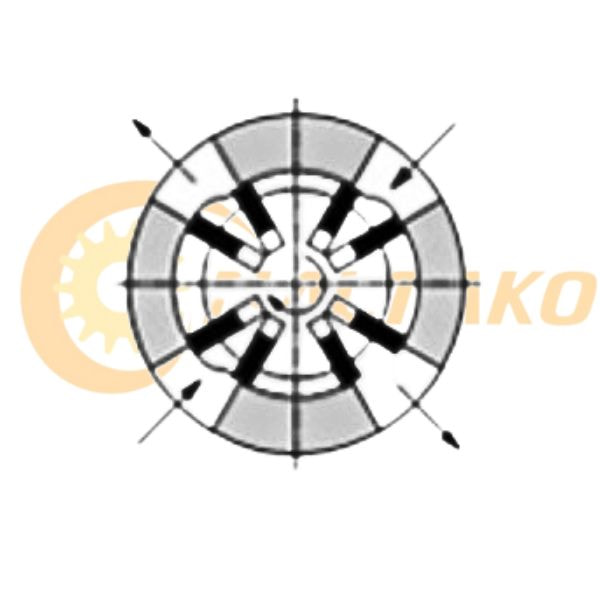
- Circle: Represents the pump body.
- Vanes: Straight lines inside the circle represent the vanes to indicate their centrifugal movement.
- Rotor: The small circle in the center represents the rotor, which is the rotating part of the pump.
- Arrow: The arrow indicates the flow direction of the hydraulic oil.
Piston Pump Symbol (Radial)

Circle: Represents the pump body.
Pistons and Cylinders: Small rectangles inside the circle represent the pistons.
Arrows: Two arrows indicate the flow direction of the hydraulic oil. Oil is sucked in from the top and pumped out at the bottom.
Surrounding Rectangle: Represents the cylinder block containing the pistons.
Reference Technical Parameters:
- Speed: 960 – 3000 rpm.
- Flow rate: 5 – 160 cm³/rev.
- Pressure: 160 – 320 bar.
- Efficiency: 0.90 (90%).
Advantages of Radial Piston Pumps:
- Generates high pressure.
- High efficiency.
- Durable lifespan.
Through this article, we hope you have mastered the basic knowledge of hydraulic pump types and their corresponding symbols. Understanding hydraulic pump symbols not only helps you read hydraulic circuit diagrams accurately but also provides great support in operating, maintaining, and repairing hydraulic systems.
Nội dung có liên quan:
-
 Which type of hydraulic oil is used for motorcycle lifts?
Have you ever encountered a motorcycle hydraulic lift operating unstable, emitting strange noises, or getting stuck midway? The cause may be due to using t...
Which type of hydraulic oil is used for motorcycle lifts?
Have you ever encountered a motorcycle hydraulic lift operating unstable, emitting strange noises, or getting stuck midway? The cause may be due to using t...
-
 Lift Table Hydraulic Pumps and Essential Factors to Know
The hydraulic pump for lift tables is an indispensable device in the critical hydraulic system of pallet trucks. The hydraulic pump ensures smooth and prec...
Lift Table Hydraulic Pumps and Essential Factors to Know
The hydraulic pump for lift tables is an indispensable device in the critical hydraulic system of pallet trucks. The hydraulic pump ensures smooth and prec...
-
 Boosting productivity with production lifting equipment
In the context of fierce competition in modern production, optimizing labor productivity is a key factor determining the success or failure of an enterpris...
Boosting productivity with production lifting equipment
In the context of fierce competition in modern production, optimizing labor productivity is a key factor determining the success or failure of an enterpris...
-
 What is a Homemade Conveyor? Should You Use DIY Conveyors?
Have you ever thought about creating your own conveyor belt to transport objects or organize items? Instead of spending a large amount of money to buy an i...
What is a Homemade Conveyor? Should You Use DIY Conveyors?
Have you ever thought about creating your own conveyor belt to transport objects or organize items? Instead of spending a large amount of money to buy an i...
-
 Detailed Container Loading and Unloading Process
In the modern maritime industry, containers play a vital role in global goods transportation. The container loading and unloading process is a critical lin...
Detailed Container Loading and Unloading Process
In the modern maritime industry, containers play a vital role in global goods transportation. The container loading and unloading process is a critical lin...
-
 What is a Chain Hoist? Structure and Applications of Hoists
A chain hoist is a lifting tool widely used in many industries and daily life. With a simple yet effective design, chain hoists help people lift and lower ...
What is a Chain Hoist? Structure and Applications of Hoists
A chain hoist is a lifting tool widely used in many industries and daily life. With a simple yet effective design, chain hoists help people lift and lower ...
-
 What is a Lifting Shackle? Structure and Applications of Lifting Shackles
How can massive blocks of cargo be moved safely and easily? The secret lies in a tiny but powerful tool: the lifting shackle. With an intelligent design an...
What is a Lifting Shackle? Structure and Applications of Lifting Shackles
How can massive blocks of cargo be moved safely and easily? The secret lies in a tiny but powerful tool: the lifting shackle. With an intelligent design an...
-
 Webbing Slings and the Benefits of Using Them
Webbing slings are a type of lifting and securing material widely used in many industries. They are manufactured from high-strength synthetic fibers with e...
Webbing Slings and the Benefits of Using Them
Webbing slings are a type of lifting and securing material widely used in many industries. They are manufactured from high-strength synthetic fibers with e...