

 Tiếng Việt
What is a Conveyor? Benefits of Using Cargo Conveyors
Before the appearance of conveyors, goods transportation relied mainly on human labor. However, due to drawbacks in efficiency and the potential for errors, this method has gradually been replaced by conveyors – a modern solution that optimizes the production process. The ease and speed of moving goods on production lines have proven that conveyors are smart, simple, and effective devices.
What is a Conveyor?
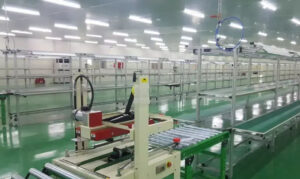
A conveyor is a mechanical device used to move goods from one place to another. Instead of transporting products by manual labor, which is time-consuming and increases labor costs, conveyors can completely solve that problem. Conveyors allow for the quick and efficient transportation of many types of materials. At the same time, workers reduce the risk of injury from having to carry heavy packages.
Detailed Component Structure of Conveyors
A conveyor is a complex mechanical system designed for efficient and continuous goods transport. Although there are many different types of conveyors, the main structure consists of:
Conveyor Frame
The conveyor frame is the primary load-bearing component, usually made of powder-coated steel, aluminum profiles, or stainless steel.
Conveyor Surface
The conveyor surface is the part in direct contact with the goods. The materials used for the surface are very diverse, ranging from PVC and PU belts to rubber. Depending on the nature of the goods being moved, the surface can take many shapes, such as flat, rollers, corrugated, or perforated.
Rollers
Rollers are used to support the conveyor surface’s movement and reduce friction. They can be made of steel, rubber, or plastic.
Drive System
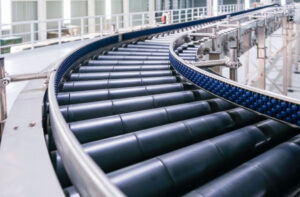
The drive system includes: the motor, reducer, pulley, belts, or chains. This system provides the power to pull the conveyor surface into motion.
Control Unit
The control unit manages the speed, direction of movement, and other functions of the conveyor. This part consists of electrical devices such as PLCs, inverters, and switches.
Other Components
Depending on the specific type of conveyor, other parts can be added, such as support tables, sensors, and guardrails.
Common Types of Conveyors Today
Conveyors are indispensable equipment in factories, warehouses, and production lines. Currently, there are many different types of conveyors, each with its own advantages and applications.
Chain Conveyor
A chain conveyor is an industrial transport system where the surface is structured with chains, using towing chains to pull products along the line.
Chain conveyors feature high durability, support heavy loads, and transport goods easily over long distances and inclined angles.
Rubber Conveyor
A thick rubber belt is mounted on a frame, and goods are transported directly on this rubber layer. The advantages of this equipment are high friction, which holds goods tightly, making it suitable for transporting products with irregular shapes.
This equipment is widely used in the food, pharmaceutical, and chemical industries.
Roller Conveyor
A roller conveyor is a system of interconnected rollers used to transport and support products. The roller system can be used for products ranging from light to very heavy weights.
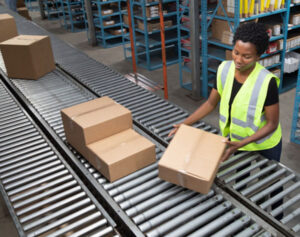
Roller conveyors are often used in warehouses, distribution centers, and production lines.
PVC Conveyor
PVC conveyors use a layer of PVC plastic for the belt. This type of conveyor is heavily utilized in the electronics industry.
PVC conveyors are corrosion-resistant, easy to clean, and suitable for transporting products with high hygiene requirements.
Heat Dissipation Conveyor
Heat dissipation conveyors have excellent heat resistance and are used in the food industry. These devices are usually constructed from stainless steel.
Heat-resistant conveyors possess various characteristics, including fire resistance, anti-static properties, and solvent resistance. They are applied in circuit soldering, food processing, and drying agricultural products.
Benefits of Using a Conveyor
Conveyors have become essential equipment in factories and warehouses. Implementing conveyors brings many benefits, helping to improve production and reduce costs. Here are some key benefits:
Improving Productivity
- Conveyors transport goods at a fast, continuous speed, shortening production time.
- Transportation tasks, from feeding lift tables to the production process, become much faster.
Minimizing Costs
- Conveyors replace human labor, significantly reducing labor costs.
- Moving goods via conveyors minimizes damage and loss during transport.
- Conveyors help organize workspace more efficiently, making the most of available floor space.
Ensuring Safety
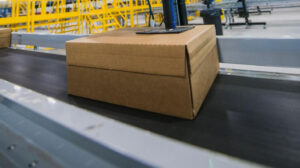
- Transporting goods by conveyor minimizes the risk of accidents caused by manual lifting and handling.
- Conveyors help mitigate risks associated with lifting heavy loads.
Increasing Flexibility
- The speed and direction of the conveyor can be easily adjusted to suit production needs.
- Conveyors can be integrated with other equipment such as robots and fixed feeding lift tables to form an automated production line.
>>> What is a slat chain conveyor? Common applications of slat chain conveyors
Conclusion
In summary, conveyors have proven their vital role in modern production lines. With the ability to transport goods continuously and accurately, these devices contribute to improving labor productivity, minimizing costs, and ensuring safety for operators. Naltako has helped you understand more about conveyors and their benefits. If you need further consultation, please contact:
CONTACT INFORMATION
Website: naltako.vn
Hotline: 0981.977.898
Email: nhat.mtk53@gmail.com
Workshop Address: Km19, Highway 6, Phuc Tien Ward, Bien Giang, Ha Dong, Hanoi
Representative Office Address: 4th Floor, SME Royal Building, To Hieu, Ha Dong, Hanoi
Nội dung có liên quan:
-
 What is a Trailer? Detailed Component Structure of Trailers
Have you ever seen giant trucks on the highway and wondered what the part behind them is? That is a trailer. It is a type of vehicle without an engine, des...
What is a Trailer? Detailed Component Structure of Trailers
Have you ever seen giant trucks on the highway and wondered what the part behind them is? That is a trailer. It is a type of vehicle without an engine, des...
-
 What is a PVC Conveyor? Advantages and Disadvantages of Use
PVC conveyors are not merely transport devices but comprehensive solutions that help businesses optimize production processes, improve product quality, and...
What is a PVC Conveyor? Advantages and Disadvantages of Use
PVC conveyors are not merely transport devices but comprehensive solutions that help businesses optimize production processes, improve product quality, and...
-
 What is a Semi-trailer? Distinguishing Between Trailers and Semi-trailers
In today's context of booming trade, semi-trailers have become an indispensable link in the freight transport system. With the capacity to carry large volu...
What is a Semi-trailer? Distinguishing Between Trailers and Semi-trailers
In today's context of booming trade, semi-trailers have become an indispensable link in the freight transport system. With the capacity to carry large volu...
-
 What is a Stainless Steel Mesh Conveyor? Current Applications of Stainless Steel Conveyors
Stainless steel mesh conveyor is a transport device constructed from stainless steel wires tightly woven together to form a mesh surface. Thanks to its div...
What is a Stainless Steel Mesh Conveyor? Current Applications of Stainless Steel Conveyors
Stainless steel mesh conveyor is a transport device constructed from stainless steel wires tightly woven together to form a mesh surface. Thanks to its div...
-
 What is a Plastic Chain Conveyor? Applications of Plastic Conveyor Chains
One of the effective and flexible goods transportation solutions in production activities is the plastic chain conveyor. This is a type of conveyor made fr...
What is a Plastic Chain Conveyor? Applications of Plastic Conveyor Chains
One of the effective and flexible goods transportation solutions in production activities is the plastic chain conveyor. This is a type of conveyor made fr...
-
 What is a Hydraulic Jack? Classification and Working Principle
A hydraulic jack is a mechanical device used to lift or adjust the position of heavy objects thanks to the operating principle of liquids. Hydraulic jacks ...
What is a Hydraulic Jack? Classification and Working Principle
A hydraulic jack is a mechanical device used to lift or adjust the position of heavy objects thanks to the operating principle of liquids. Hydraulic jacks ...
-
 What is a Mini Overhead Crane? Applications of Mini Overhead Cranes
Mini overhead cranes are a type of lifting equipment designed with a compact size and lighter weight compared to traditional overhead cranes. They are typi...
What is a Mini Overhead Crane? Applications of Mini Overhead Cranes
Mini overhead cranes are a type of lifting equipment designed with a compact size and lighter weight compared to traditional overhead cranes. They are typi...
-
 Truck-Mounted Mini Cranes: Benefits and Outstanding Features
The transportation and unloading of goods play an extremely important role, especially in the industrial, construction, and transport sectors. Owning a min...
Truck-Mounted Mini Cranes: Benefits and Outstanding Features
The transportation and unloading of goods play an extremely important role, especially in the industrial, construction, and transport sectors. Owning a min...