

 Tiếng Việt
Hydraulics: Concept, Structure, and Basic Operating Principles
Hydraulics is a vital technology, widely used in modern life. From industrial machinery like dock levelers to vehicles, this system plays an indispensable role.
In the article below, we will explore hydraulic systems in a simple and easy-to-understand way. You will learn about the concept, structure, and operating principles. Whether you are an engineer or just curious about technology, Naltako’s article will provide you with a comprehensive overview of hydraulics.
What is Hydraulics?
Hydraulics is a branch of science and engineering that studies the movement and energy transmission of fluids (hydraulic oil, lubricant, etc.) within a closed system. When a fluid is compressed, it creates pressure, which in turn generates force to perform work.
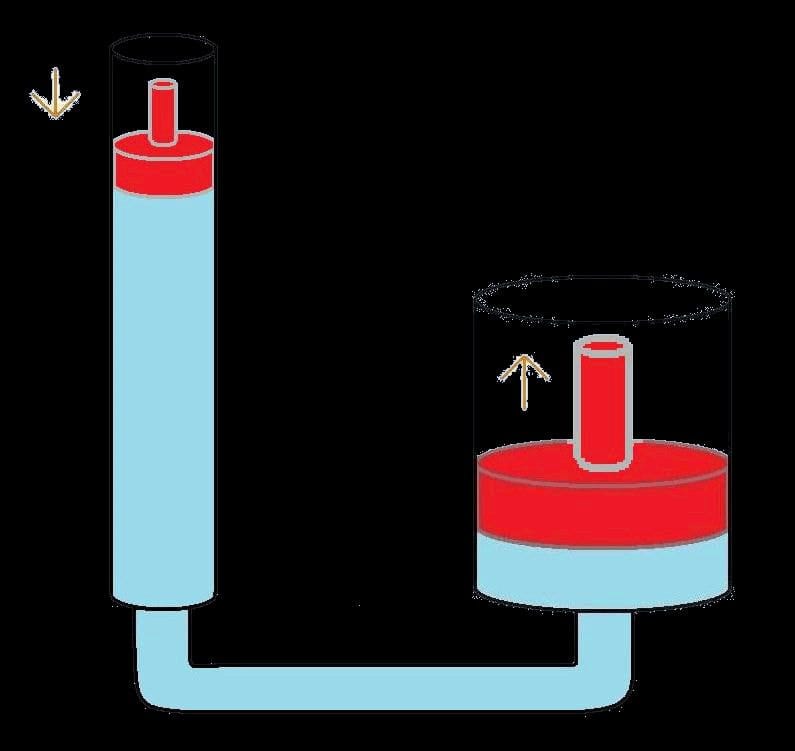
Hydraulic systems are widely applied in many industrial fields such as production, machinery manufacturing, aviation, shipbuilding, automotive assembly, mining, heavy industry, and even in advanced robotics.
Structure of a Hydraulic System
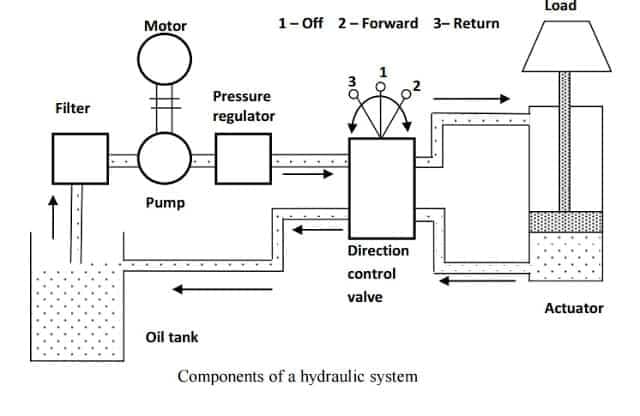
Hydraulic Cylinder: A linear actuator that converts hydraulic energy into mechanical motion in a straight line. It consists of a cylinder barrel, cylinder head, piston, piston rod, seals, and oil guiding components.
Hydraulic Motor: Similar to a hydraulic cylinder but creates rotary motion. Hydraulic motors provide energy for rotating parts such as conveyor belts, wheels, etc.
Hydraulic Pump: Plays a central role in the system, converting mechanical energy into hydraulic energy. The pump sucks oil from the reservoir and pushes it into the system under high pressure.
Pressure Regulator: Maintains stable pressure in the system by adjusting the oil flow through the valve.
Directional Control Valve: Controls the flow direction of hydraulic oil, determining the movement direction of the actuator. This valve has 3 positions:
- 1-Off: Stops the flow, no movement.
- 2-Forward: Oil flows into the actuator, pushing it forward.
- 3-Return: Oil flows out of the actuator, pulling it back to the original position.
Actuator: Converts hydraulic energy into mechanical motion. In this diagram, the actuator is a hydraulic cylinder, creating linear motion.
Load: The object or resistance force that the actuator must act upon.
Oil Tank: Stores hydraulic oil when the system is not operating and supplies oil to the pump when needed.
Basic Technical Specifications of Hydraulics
In hydraulics, there are two basic parameters (quantities) that play a vital role in determining the performance and working capacity of the system:
Flow rate: The volume of hydraulic oil transported by the pump per unit of time. Flow rate directly affects the movement speed of actuators like cylinders or hydraulic motors. The higher the flow rate, the faster the movement. Common units are liters per minute (l/min) or cubic centimeters per revolution (cc/rev).
Pressure: The force exerted on a unit area of the fluid. In a hydraulic system, pressure is created by the pump and acts on the actuators to generate force and motion. The higher the pressure, the greater the force produced. Common units are bar, megapascal (MPa), or pounds per square inch (psi).
Operating Principle of a Hydraulic System
The operating principle of a hydraulic system is based on converting mechanical energy into hydraulic energy, then transmitting and amplifying force through a fluid (hydraulic oil).
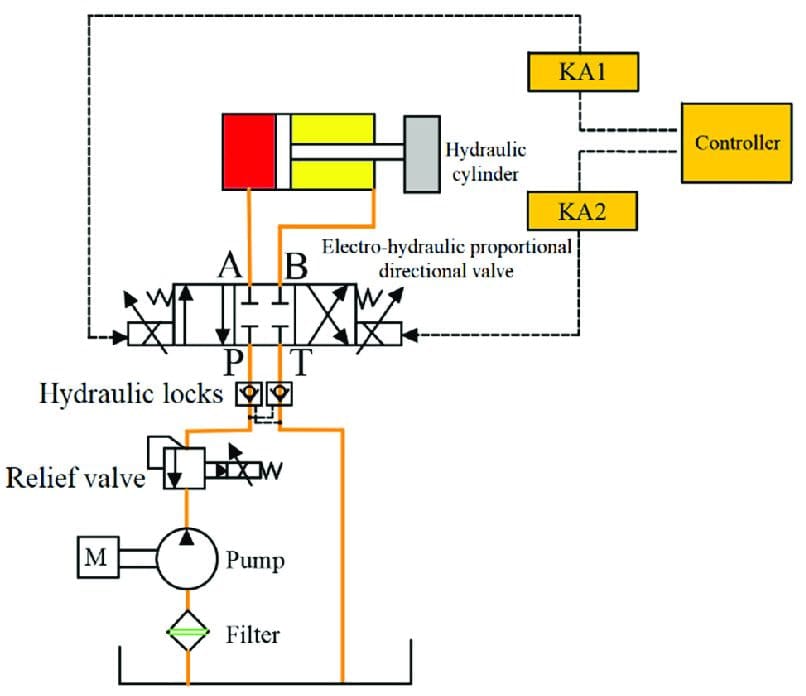
The above hydraulic system schematic describes a system controlling a hydraulic cylinder using a proportional electro-hydraulic valve. This system includes the following main components:
-
Hydraulic Pump: Converts mechanical energy into hydraulic energy by sucking oil from the reservoir and pushing it into the system under high pressure. The motor (M) provides energy for the pump to operate.
-
Filter: Ensures the hydraulic oil is clean before entering the system, protecting other components from damage caused by debris.
-
Electro-hydraulic proportional directional valve: This valve controls the direction and flow rate of hydraulic oil to the cylinder, thereby controlling the cylinder’s movement. The valve receives control signals from the Controller.
-
Hydraulic locks: These locks are installed at the P and T ports of the valve to hold the cylinder in a fixed position when there is no control signal.
-
Hydraulic cylinder: Converts hydraulic energy into linear motion. The cylinder is controlled by the proportional electro-hydraulic valve to perform lifting, lowering, or pushing operations.
-
Relief valve: Protects the system from excessive pressure by discharging oil back to the reservoir when the pressure exceeds the allowable limit.
-
Controller: Sends electrical signals to the proportional electro-hydraulic valve to control the cylinder’s movement. The controller can receive signals from an operator or from sensors within the system.
-
KA1 and KA2: Represent sensors or limit switches for the cylinder’s stroke.
Operating Principle Description:
- When the controller sends an electrical signal to the proportional electro-hydraulic valve, the valve opens and allows hydraulic oil to flow into one port of the cylinder, while oil from the other port is discharged back to the reservoir.
- The hydraulic oil pushes the cylinder piston, creating linear motion.
- When the controller stops sending the signal, the valve closes and the hydraulic lock holds the cylinder in its current position.
- The relief valve will open if the system pressure exceeds the allowable limit, protecting the system from damage.
The above diagram and description are just one example of a hydraulic system. In reality, there are many different types of hydraulic systems with more complex structures and operating principles.
>>> How to prevent accidents when using hydraulic lifting equipment
Advantages and Disadvantages of Hydraulic Control Systems
Advantages
- Hydraulics can generate large forces and torques, suitable for heavy industrial applications like hydraulic lift tables.
- Velocity, direction, and force can be easily and precisely adjusted.
- Hydraulic systems are often more compact than other drive systems of the same power.
- High starting torque helps the system easily overcome initial inertia.
- Less vibration and noise, especially at high speeds.
- Relief valves help prevent overload, protecting the system.
- System pressure can be continuously monitored via gauges and sensors.
- Easy to integrate with automated control systems.
Disadvantages
- Friction in pipes and other components can reduce system efficiency.
- Air bubbles in hydraulic oil can cause noise, reduce efficiency, and damage components.
- Changes in oil temperature can affect viscosity and system performance.
- Oil leaks cause environmental pollution and fire hazards if not handled promptly.
- Initial investment costs for hydraulic systems are often higher than other solutions like pneumatics.
Applications of Hydraulics in Daily Life
Industry
- Construction machinery: Excavators, bulldozers, cranes, drilling rigs, pile drivers, etc.
- Lifting equipment: Hydraulic cargo lifts, personnel lifts, loading docks, pallet jacks…
- Manufacturing machinery: Plastic injection molding machines, metal stamping machines, CNC cutters, etc.
- Automation systems: Industrial robots, production lines, etc.
Transportation
- Automobiles: Braking systems, power steering, suspension systems, etc.
- Aircraft: Flight control systems, landing gear, braking, etc.
- Ships: Steering systems, anchoring, etc.
Agriculture
- Tractors: Lifting and control systems, etc.
- Combine harvesters: Control systems, etc.
Other Fields
- Medical: Dental chairs, operating tables, etc.
- Military: Tanks, fighter jets, etc.
Thanks to its flexibility, ability to transmit large forces, and high precision, hydraulics has become an indispensable part of many fields, contributing to increased productivity and work efficiency.
You may be interested in: Building a professional inventory management system in logistics
Hydraulic System Maintenance and Repair
Hydraulic system maintenance plays a crucial role in ensuring the performance and lifespan of industrial machinery. In the past, maintenance often only occurred when a failure happened. However, with the development of technology and modern production scales, periodic and preventive maintenance is necessary to minimize downtime and repair costs.
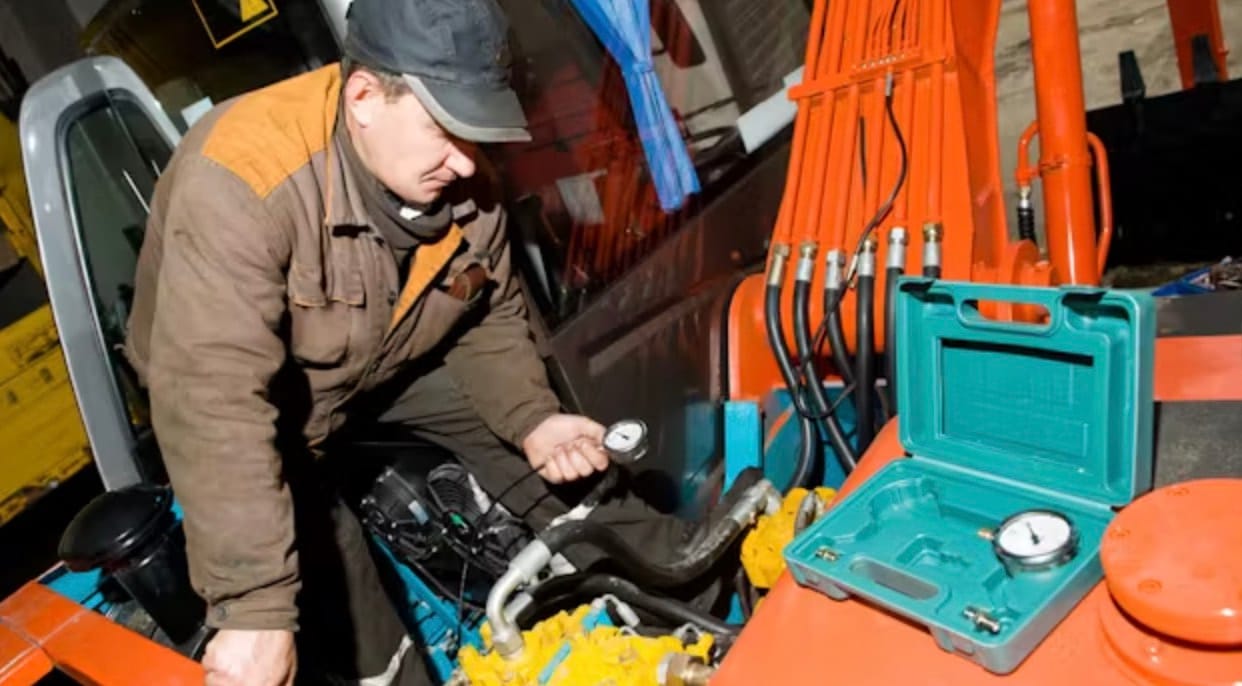
Common causes of hydraulic system failure:
- Oil filter is contaminated or clogged
- Oil leakage through seals
- Lack of oil in the reservoir
- Loose pipe joints causing air cavitation in the pump
- Using inappropriate hydraulic oil
- Excessive oil pressure
- Excessive oil temperature
To prevent the above issues, a comprehensive preventive maintenance program is required, including:
- Selecting high-quality components suitable for operating requirements.
- Ensuring tight joints, correct torque, and thorough system flushing before use.
- Regularly checking critical parts such as filters, oil sight glasses, pressure gauges, and temperature sensors.
- Sampling and testing oil quality to detect early signs of abnormalities.
- Ensuring operating and maintenance staff are fully trained to recognize and handle potential incidents.
- Storing information on incidents, corrective measures, and maintenance history to analyze and improve system performance.
In addition to maintenance, environmental issues related to hydraulic systems should be noted, including:
- Using environmentally friendly bio-hydraulic oil.
- Properly storing and disposing of waste oil.
- Minimizing noise and oil leakage.
Conclusion
Through this article, Naltako hopes you have gained a better understanding of hydraulics, from basic concepts to practical applications. This is not only useful knowledge but can also help you make the right decisions in work and life.
If you need advice on hydraulic solutions for your business, do not hesitate to contact us.
Nội dung có liên quan:
-
 What is a Loading Dock? What does a Loading Dock system include?
Is your business facing difficulties in transporting goods? Is loading and unloading taking too much time and increasing costs? Have you researched solutio...
What is a Loading Dock? What does a Loading Dock system include?
Is your business facing difficulties in transporting goods? Is loading and unloading taking too much time and increasing costs? Have you researched solutio...
-
 Hydraulic Cylinder Structure, Specifications, and Operating Principles
Hydraulic cylinders, also known as hydraulic rams, are one of the most critical components in a hydraulic system. They have the ability to convert hydrauli...
Hydraulic Cylinder Structure, Specifications, and Operating Principles
Hydraulic cylinders, also known as hydraulic rams, are one of the most critical components in a hydraulic system. They have the ability to convert hydrauli...
-
 Differences Between Freight Elevators and Goods Hoists
Choosing between a freight elevator and a goods hoist is always a difficult puzzle for many businesses. Understanding this, Naltako will help you solve the...
Differences Between Freight Elevators and Goods Hoists
Choosing between a freight elevator and a goods hoist is always a difficult puzzle for many businesses. Understanding this, Naltako will help you solve the...
-
 Dock Shelter and Dock Leveler: The Perfect Combination for Your Warehouse
Is your warehouse operating inefficiently, with high risks of cargo damage and low productivity? Don't worry, the optimal solution is here! The combination...
Dock Shelter and Dock Leveler: The Perfect Combination for Your Warehouse
Is your warehouse operating inefficiently, with high risks of cargo damage and low productivity? Don't worry, the optimal solution is here! The combination...
-
 What is a Raised Floor? What are the components of its structure?
Raised floors, hydraulic dock levelers, and access floors are popular types of flooring widely used in modern construction engineering today. To learn deta...
What is a Raised Floor? What are the components of its structure?
Raised floors, hydraulic dock levelers, and access floors are popular types of flooring widely used in modern construction engineering today. To learn deta...
-
 What is Hydraulic? Everything You Need to Know About Hydraulics
"Hydraulic" is certainly a term that many people are interested in. In Vietnamese, it translates to "thủy lực." Today, common industrial machinery within h...
What is Hydraulic? Everything You Need to Know About Hydraulics
"Hydraulic" is certainly a term that many people are interested in. In Vietnamese, it translates to "thủy lực." Today, common industrial machinery within h...
-
 What is a food lift?
Food lifts are commonly found equipment in large restaurants and hotels. They are easy-to-use vehicles due to their compact and safe design. Improving qual...
What is a food lift?
Food lifts are commonly found equipment in large restaurants and hotels. They are easy-to-use vehicles due to their compact and safe design. Improving qual...
-
 Guide to selecting used hydraulic cylinders effectively
Hydraulic cylinders play a vital role in hydraulic systems by providing high working efficiency. Currently, many people use used hydraulic cylinders to sav...
Guide to selecting used hydraulic cylinders effectively
Hydraulic cylinders play a vital role in hydraulic systems by providing high working efficiency. Currently, many people use used hydraulic cylinders to sav...