

 Tiếng Việt
Differences Between Freight Elevators and Goods Hoists
Choosing between a freight elevator and a goods hoist is always a difficult puzzle for many businesses. Understanding this, Naltako will help you solve the problem by providing a detailed analysis of the differences between these two types of equipment, from operating principles and pros and cons to practical applications.
Through this, you can find the optimal solution and choose the equipment that best suits your needs and conditions, ensuring work efficiency and cost savings.
General Overview of Freight Elevators and Goods Hoists
Freight Elevator
A freight elevator or cargo lift is a device used to lift and move goods between different floors or heights. Freight elevators are commonly used in households, factories, production workshops, warehouses, and many other environments to increase work efficiency and minimize human labor.
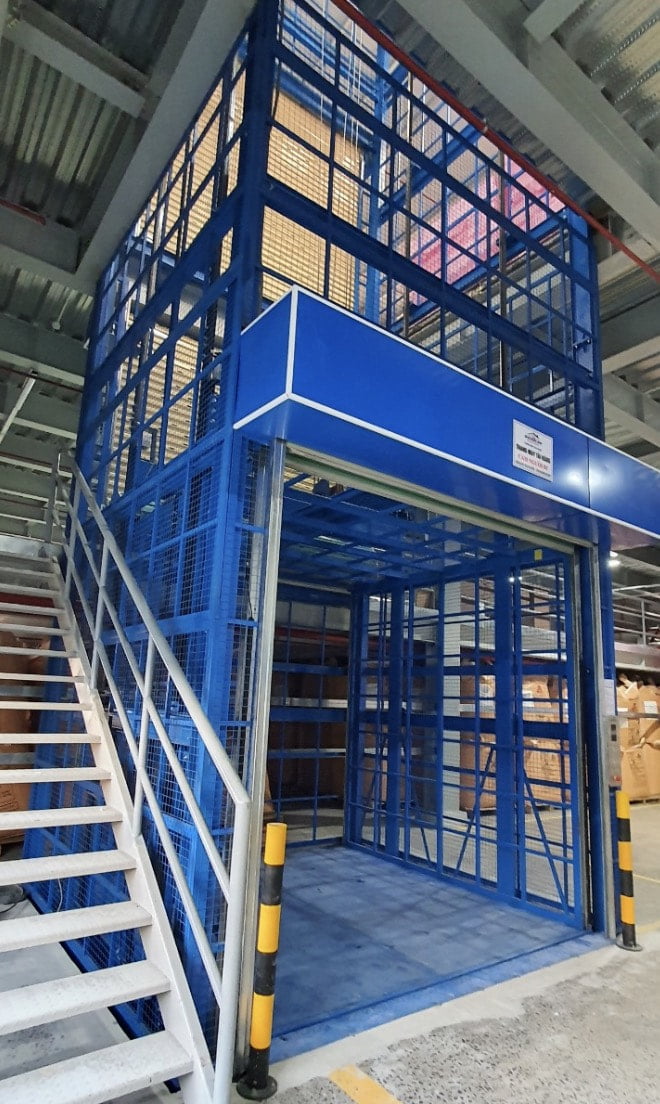
Characteristics of Freight Elevators:
- Used in various environments, from households to large industrial facilities.
- The product can be adapted to lift people thanks to high safety features and aesthetics.
- Using a freight elevator minimizes the time and effort required to transport goods by hand, thereby increasing productivity and reducing labor costs.
- Freight elevators are capable of lifting large loads, from a few hundred kilograms to several tons, depending on the type and design.
- Most are hydraulic freight elevators to generate large lifting force, ensuring stable and safe operation.
See more:
Most accurate technical specifications for hydraulic freight elevators
Goods Hoist
A goods hoist is a specialized device for lifting and moving goods between different floors or heights. Goods hoists are designed to be minimalist, compact, and cost-effective; they are not used to lift people.
Characteristics of Goods Hoists:
- Goods hoists are only used for lifting and moving goods, not for lifting people.
- Simple, compact structure helps save on investment and installation costs.
- Load capacity ranges from 100kg to 2000kg, suitable for lifting medium and small weight goods.
- Due to the smaller load capacity, the device can use a mini hydraulic hoist or an electric motor, depending on usage needs and cargo weight.
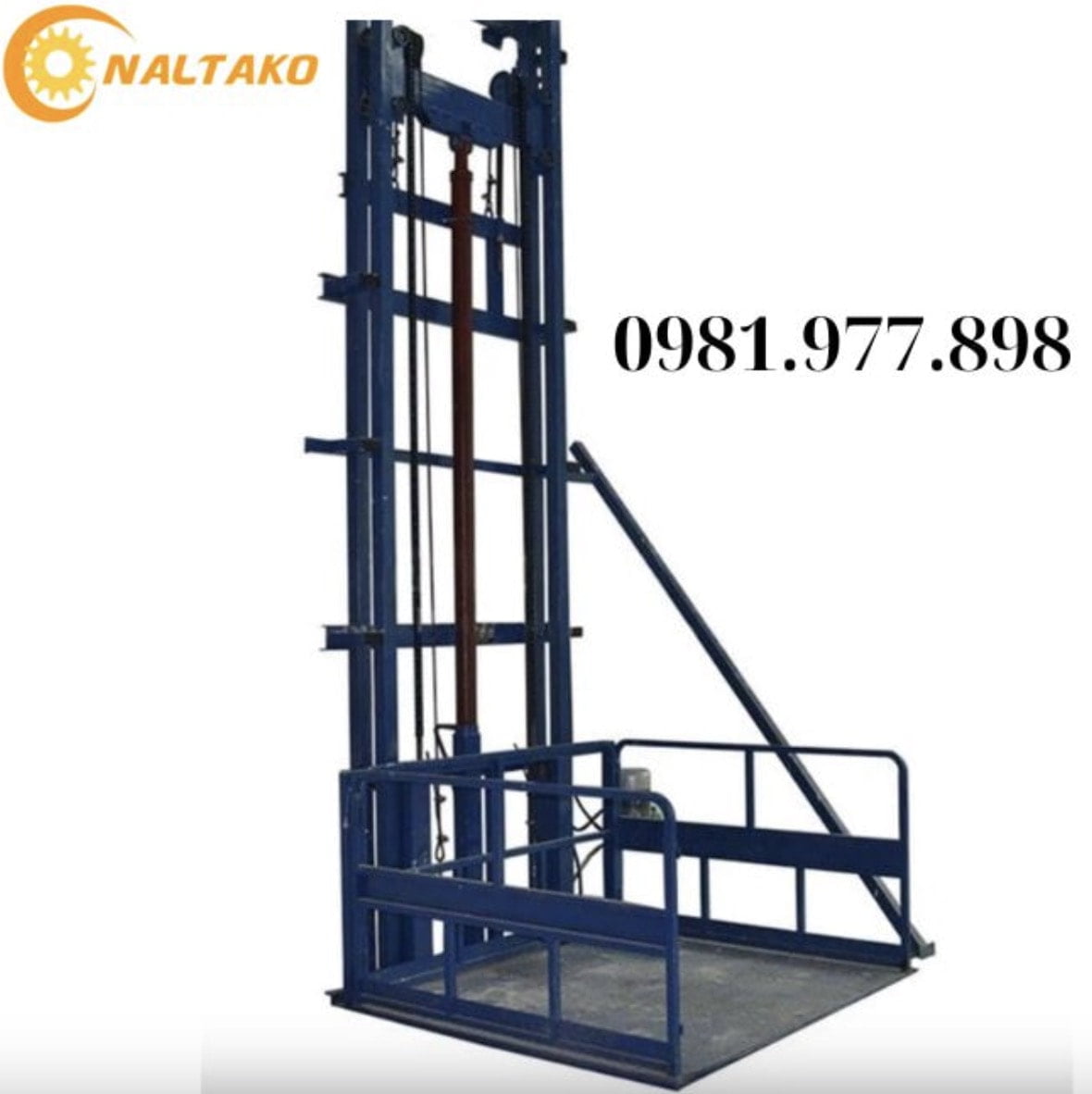
Thus, although there are differences in design, load capacity, and features, both freight elevators and goods hoists share the common goal of supporting the efficient and safe lifting and moving of goods.
Reference:
Should you choose a hydraulic freight elevator or a motor hoist?
Comparison between Freight Elevators and Goods Hoists
| Features | Freight Elevator | Goods Hoist |
| Main Function | Lifting and moving goods or people between floors or heights |
Only used for lifting and moving goods or materials between floors or heights
|
| Design | Available in many designs, such as scissor lifts, 1-post, 2-post, 4-post… |
Simple, compact design, usually in the form of a vertical shaft with cables or chains for lifting.
|
| Load Capacity | Capable of lifting large loads, from a few hundred kg to several tons |
Light load capacity, usually from 100kg to 2000kg
|
| Lifting System | Usually uses a hydraulic system |
Can use a hydraulic lifting system or an electric motor
|
| Cost | Higher price due to more complex design |
Cheaper price due to simple design
|
| Application | Suitable for frequent lifting of heavy, bulky goods that need vertical movement |
Suitable for lifting light to medium goods where high flexibility is not required
|
Should you choose a freight elevator or a goods hoist?
Who is suited for a Freight Elevator?
Manufacturing businesses, factories, and warehouses that need to transport heavy, bulky goods frequently between floors.
Construction sites needing to lift building materials to higher levels.
Commercial centers and supermarkets needing to move goods between floors for display or storage.
Industries with needs for heavy and frequent lifting.
Can be combined for use as a passenger lift.
Refer further:
Who is suited for a Goods Hoist?
Households needing to lift furniture and household items to upper floors.
Small shops and restaurants needing to transport light or medium goods between floors.
Small manufacturing or repair workshops needing to lift machinery, equipment, and materials of moderate weight.
Small construction projects needing to lift light building materials.
Conclusion
In summary, both freight elevators and goods hoists are useful solutions for lifting and moving goods. However, each type of equipment is suitable for different needs and environments.
We hope the information provided by Naltako.vn in this article has helped you better understand the differences between a freight elevator and a goods hoist, thereby helping you make the most appropriate choice for your needs.
Nội dung có liên quan:
-
 What is a Loading Dock? What does a Loading Dock system include?
Is your business facing difficulties in transporting goods? Is loading and unloading taking too much time and increasing costs? Have you researched solutio...
What is a Loading Dock? What does a Loading Dock system include?
Is your business facing difficulties in transporting goods? Is loading and unloading taking too much time and increasing costs? Have you researched solutio...
-
 Hydraulic Cylinder Structure, Specifications, and Operating Principles
Hydraulic cylinders, also known as hydraulic rams, are one of the most critical components in a hydraulic system. They have the ability to convert hydrauli...
Hydraulic Cylinder Structure, Specifications, and Operating Principles
Hydraulic cylinders, also known as hydraulic rams, are one of the most critical components in a hydraulic system. They have the ability to convert hydrauli...
-
 Hydraulics: Concept, Structure, and Basic Operating Principles
Hydraulics is a vital technology, widely used in modern life. From industrial machinery like dock levelers to vehicles, this system plays an indispensable ...
Hydraulics: Concept, Structure, and Basic Operating Principles
Hydraulics is a vital technology, widely used in modern life. From industrial machinery like dock levelers to vehicles, this system plays an indispensable ...
-
 Dock Shelter and Dock Leveler: The Perfect Combination for Your Warehouse
Is your warehouse operating inefficiently, with high risks of cargo damage and low productivity? Don't worry, the optimal solution is here! The combination...
Dock Shelter and Dock Leveler: The Perfect Combination for Your Warehouse
Is your warehouse operating inefficiently, with high risks of cargo damage and low productivity? Don't worry, the optimal solution is here! The combination...
-
 What is a Raised Floor? What are the components of its structure?
Raised floors, hydraulic dock levelers, and access floors are popular types of flooring widely used in modern construction engineering today. To learn deta...
What is a Raised Floor? What are the components of its structure?
Raised floors, hydraulic dock levelers, and access floors are popular types of flooring widely used in modern construction engineering today. To learn deta...
-
 What is Hydraulic? Everything You Need to Know About Hydraulics
"Hydraulic" is certainly a term that many people are interested in. In Vietnamese, it translates to "thủy lực." Today, common industrial machinery within h...
What is Hydraulic? Everything You Need to Know About Hydraulics
"Hydraulic" is certainly a term that many people are interested in. In Vietnamese, it translates to "thủy lực." Today, common industrial machinery within h...
-
 What is a food lift?
Food lifts are commonly found equipment in large restaurants and hotels. They are easy-to-use vehicles due to their compact and safe design. Improving qual...
What is a food lift?
Food lifts are commonly found equipment in large restaurants and hotels. They are easy-to-use vehicles due to their compact and safe design. Improving qual...
-
 Guide to selecting used hydraulic cylinders effectively
Hydraulic cylinders play a vital role in hydraulic systems by providing high working efficiency. Currently, many people use used hydraulic cylinders to sav...
Guide to selecting used hydraulic cylinders effectively
Hydraulic cylinders play a vital role in hydraulic systems by providing high working efficiency. Currently, many people use used hydraulic cylinders to sav...