

 Tiếng Việt
What is a Trailer? Detailed Component Structure of Trailers
Have you ever seen giant trucks on the highway and wondered what the part behind them is? That is a trailer. It is a type of vehicle without an engine, designed to be combined with a tractor unit to form a transport combination capable of carrying large volumes of goods. Thanks to its specialized structure and diverse types, trailers have become an indispensable tool in the modern transport industry.
What is a Trailer?
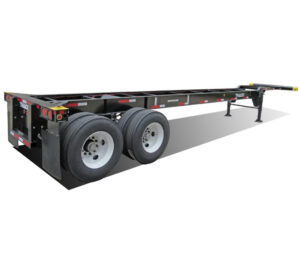
What is a trailer truck? A trailer truck is a tractor unit used to pull a trailer. This is a transport vehicle designed to carry goods and machinery. However, this vehicle has no engine and cannot run on its own.
You may be interested in: What is a semi-trailer? Distinguishing between trailers and semi-trailers
Structure of a Trailer Truck
A trailer truck is a combination transport vehicle consisting of two main parts: the tractor (towing vehicle) and the trailer. The tractor is used to pull the trailer, while the trailer is the part responsible for containing the goods.
Tractor (Towing Vehicle)
The tractor is the front part of the combination, equipped with an engine and a control system. It is specifically designed to pull trailers with heavy loads.
Main parts of the tractor:
- Cabin: Where the driver controls the vehicle, containing control devices, gauges, and safety systems.
- Engine: Provides the power to pull the trailer, usually a high-capacity diesel engine.
- Drivetrain: Includes the gearbox, drive shaft, and drive axle, transmitting engine power to the wheels.
- Suspension system: Helps reduce vibration during movement, ensuring stability and comfort for the driver.
- Braking system: Ensures safety during operation.
- Fifth wheel/Coupler: Connects the tractor to the trailer.
Trailer
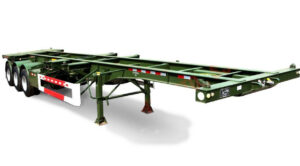
The trailer is the rear part, without an engine, responsible for containing and transporting goods.
Main parts of the trailer:
- Frame: The main load-bearing part, made of steel or aluminum alloy, ensuring durability and high load capacity.
- Floor: Can be a flatbed, skeletal floor, or specialized floor for specific types of goods.
- Side walls: Protect goods from external impacts.
- Axles: Support the weight of the cargo and help the trailer move.
- Suspension system: Helps reduce vibration during movement, protecting the goods and extending the trailer’s lifespan.
- Braking system: Ensures safety during transportation.
- Kingpin: Connects to the towing vehicle.
>>> What is a Doosung dump trailer? Where to buy?
Commonly Used Types of Trailers Today
Each type of trailer has different advantages, depending on the customer’s cargo. Below are the commonly used types of trailer trucks:
- Flatbed trailer: Used for goods that are not too heavy and do not require special protection.
- Curtainside trailer: Has a curtain cover for the goods, suitable for transporting goods that are not too high.
- Container trailer: Used to carry standard containers.
- Dump trailer: Equipped with a hydraulic lifting system for self-unloading.
- Car carrier trailer: Used for transporting automobiles.
- And many other types: Logging trailers, chemical tankers, feed trailers…
Conclusion
Trailers have proven their important role in the modern transport system. With the ability to transport diverse and large volumes of goods, trailers have contributed to the development of many economic sectors. Naltako has helped you better understand what a trailer is and related information. If you have any questions, please contact:
CONTACT INFORMATION
Website: naltako.vn
Hotline: 0981.977.898
Email: nhat.mtk53@gmail.com
Factory Address: Km19, Highway 6, Phuc Tien Ward, Bien Giang, Ha Dong, Hanoi
Representative Office Address: 4th Floor, SME Royal Building, To Hieu, Ha Dong, Hanoi
Nội dung có liên quan:
-
 What is a Conveyor? Benefits of Using Cargo Conveyors
Before the appearance of conveyors, goods transportation relied mainly on human labor. However, due to drawbacks in efficiency and the potential for errors...
What is a Conveyor? Benefits of Using Cargo Conveyors
Before the appearance of conveyors, goods transportation relied mainly on human labor. However, due to drawbacks in efficiency and the potential for errors...
-
 What is a PVC Conveyor? Advantages and Disadvantages of Use
PVC conveyors are not merely transport devices but comprehensive solutions that help businesses optimize production processes, improve product quality, and...
What is a PVC Conveyor? Advantages and Disadvantages of Use
PVC conveyors are not merely transport devices but comprehensive solutions that help businesses optimize production processes, improve product quality, and...
-
 What is a Semi-trailer? Distinguishing Between Trailers and Semi-trailers
In today's context of booming trade, semi-trailers have become an indispensable link in the freight transport system. With the capacity to carry large volu...
What is a Semi-trailer? Distinguishing Between Trailers and Semi-trailers
In today's context of booming trade, semi-trailers have become an indispensable link in the freight transport system. With the capacity to carry large volu...
-
 What is a Stainless Steel Mesh Conveyor? Current Applications of Stainless Steel Conveyors
Stainless steel mesh conveyor is a transport device constructed from stainless steel wires tightly woven together to form a mesh surface. Thanks to its div...
What is a Stainless Steel Mesh Conveyor? Current Applications of Stainless Steel Conveyors
Stainless steel mesh conveyor is a transport device constructed from stainless steel wires tightly woven together to form a mesh surface. Thanks to its div...
-
 What is a Plastic Chain Conveyor? Applications of Plastic Conveyor Chains
One of the effective and flexible goods transportation solutions in production activities is the plastic chain conveyor. This is a type of conveyor made fr...
What is a Plastic Chain Conveyor? Applications of Plastic Conveyor Chains
One of the effective and flexible goods transportation solutions in production activities is the plastic chain conveyor. This is a type of conveyor made fr...
-
 What is a Hydraulic Jack? Classification and Working Principle
A hydraulic jack is a mechanical device used to lift or adjust the position of heavy objects thanks to the operating principle of liquids. Hydraulic jacks ...
What is a Hydraulic Jack? Classification and Working Principle
A hydraulic jack is a mechanical device used to lift or adjust the position of heavy objects thanks to the operating principle of liquids. Hydraulic jacks ...
-
 What is a Mini Overhead Crane? Applications of Mini Overhead Cranes
Mini overhead cranes are a type of lifting equipment designed with a compact size and lighter weight compared to traditional overhead cranes. They are typi...
What is a Mini Overhead Crane? Applications of Mini Overhead Cranes
Mini overhead cranes are a type of lifting equipment designed with a compact size and lighter weight compared to traditional overhead cranes. They are typi...
-
 Truck-Mounted Mini Cranes: Benefits and Outstanding Features
The transportation and unloading of goods play an extremely important role, especially in the industrial, construction, and transport sectors. Owning a min...
Truck-Mounted Mini Cranes: Benefits and Outstanding Features
The transportation and unloading of goods play an extremely important role, especially in the industrial, construction, and transport sectors. Owning a min...