

 Tiếng Việt
What is a Loading Ramp? Applications of Ramps in Goods Transportation
What is a Loading Ramp?
A loading ramp, also known as a yard ramp or forklift ramp, is a powerful support device in the transportation of goods.
Essentially, a loading ramp (Inclined plane) is a sloped surface designed to connect two surfaces of different heights, facilitating the movement of goods by forklifts or other transport equipment easily and safely.

The structure of a loading ramp typically includes the following main components:
- Ramp surface: Usually made of steel or aluminum, with a serrated or textured surface to increase traction and prevent slipping.
- Support legs: Ensure the firmness and stability of the ramp, often height-adjustable to suit different vehicles and terrains.
- Lifting system: This system helps adjust the height of the ramp surface easily.
- Handrails and safety curbs: Ensure safety for the operator and goods during the movement process.
Benefits and Applications of Loading Ramps in Goods Transportation
Benefits
☑️ The device acts as a forklift ramp, helping to shorten loading and unloading times, increase productivity, and reduce labor costs.
☑️ Minimizes the risk of occupational accidents when moving goods up and down trucks or containers.
☑️ Minimizes impact and damage to goods during transportation.
☑️ Reduces repair and maintenance costs for forklifts and transport vehicles.
☑️ Mobile ramps for forklifts are easy to move and install, suitable for various terrains and usage needs.
Applications
✔️ Truck loading ramps help forklifts easily move goods onto and off truck beds, especially trucks with high floors.
✔️ Container loading ramps connect the ground to the container floor, facilitating the loading and unloading of goods by forklift.
✔️ Connecting warehouses with transport vehicles helps forklifts move goods between the warehouse and transport vehicles quickly and safely.
Types of Loading Ramps in Goods Transportation
Mobile Type
The device can be moved and installed easily thanks to a heavy-duty wheel system, suitable for non-fixed work locations. Mobile ramps are also known as mobile yard ramps.

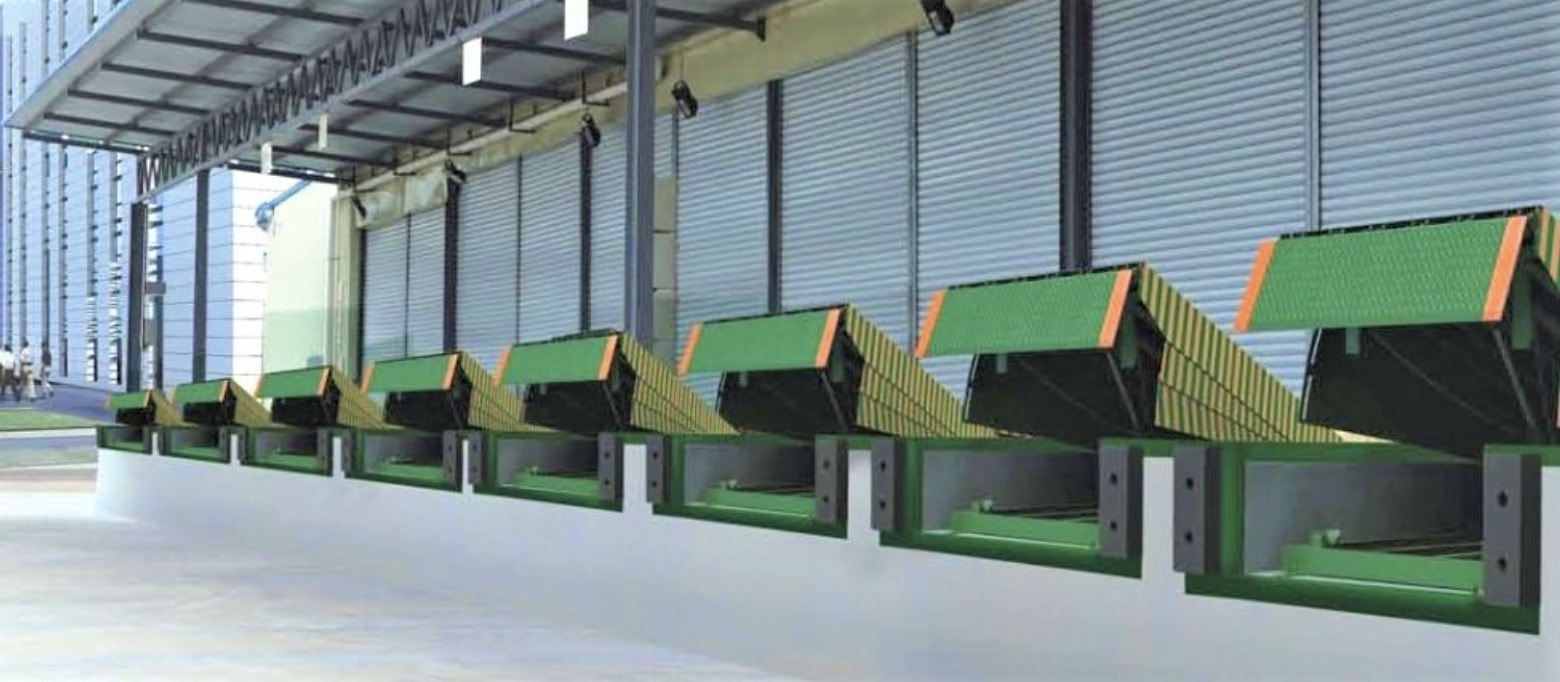
Stationary Type
The device is permanently installed at a pre-constructed dock pit, commonly used in warehouses and yards. The advantage of this type is its high load capacity, stability, and durability over time.
Stationary ramps are similar to dock levelers used in loading bays.
How to Choose the Right Loading Ramp
To choose the right ramp, you need to consider the following factors:
✅ Ramp type: Choose between stationary or mobile types based on mobility needs and frequency of use.
✅ Load capacity: Choose a loading ramp with a capacity suitable for the types of goods and forklifts you use.
✅ Dimensions: The size of the mobile forklift ramp must be wide enough for the forklift to move comfortably and safely.
✅ Material: Ramps are usually made of steel or aluminum; you should choose a material suitable for the working environment and usage frequency.
✅ Safety: Ensure the device has safety features such as handrails, curbs, and non-slip surfaces.
✅ Cost: Compare prices and quality from different suppliers to choose a loading ramp that fits your budget.
Conclusion
A loading ramp is an indispensable solution for optimizing the goods transportation process.
With outstanding benefits in efficiency, safety, and cost savings, container loading ramps and hydraulic dock levelers are increasingly widely applied in the industrial and logistics sectors.
Nội dung có liên quan:
-
 What is a scissor mechanism? Applications of scissor mechanisms in hydraulic lifting equipment
Today, scissor mechanisms are widely applied in hydraulic lifting equipment. These applications are extensively used in construction projects and bring hig...
What is a scissor mechanism? Applications of scissor mechanisms in hydraulic lifting equipment
Today, scissor mechanisms are widely applied in hydraulic lifting equipment. These applications are extensively used in construction projects and bring hig...
-
 Applications of dock levelers in production
A Dock Leveler is not just a bridge between the warehouse and the transport vehicle, but also a powerful assistant that helps you operate your production p...
Applications of dock levelers in production
A Dock Leveler is not just a bridge between the warehouse and the transport vehicle, but also a powerful assistant that helps you operate your production p...
-
 When should a Dock Leveler be repaired or replaced?
Dock Levelers are essential equipment in the process of importing and exporting goods at warehouses. Continuous operation and heavy loads make Dock Leveler...
When should a Dock Leveler be repaired or replaced?
Dock Levelers are essential equipment in the process of importing and exporting goods at warehouses. Continuous operation and heavy loads make Dock Leveler...
-
 Safe goods transportation with hoist rental services
To ensure optimal safety and work efficiency when working at height, using an aerial lift is an entirely reasonable and necessary choice. Aerial lifts not ...
Safe goods transportation with hoist rental services
To ensure optimal safety and work efficiency when working at height, using an aerial lift is an entirely reasonable and necessary choice. Aerial lifts not ...
-
 Applications of Dock Levelers in Logistics Operations
Hydraulic dock levelers have proven to be an indispensable role in enhancing productivity and ensuring safety in logistics operations. This is a powerful t...
Applications of Dock Levelers in Logistics Operations
Hydraulic dock levelers have proven to be an indispensable role in enhancing productivity and ensuring safety in logistics operations. This is a powerful t...
-
 Superior Advantages of Dock Levelers Compared to Traditional Unloading
Compared to traditional loading and unloading methods, Dock Levelers offer superior advantages. They have significantly contributed to enhancing productivi...
Superior Advantages of Dock Levelers Compared to Traditional Unloading
Compared to traditional loading and unloading methods, Dock Levelers offer superior advantages. They have significantly contributed to enhancing productivi...
-
 Pitless Hydraulic Dock Leveler: Rapid Installation, Immediate Efficiency
Although installing hydraulic dock levelers is now easy, not every facility has the conditions to construct a traditional dock pit. The pitless hydraulic d...
Pitless Hydraulic Dock Leveler: Rapid Installation, Immediate Efficiency
Although installing hydraulic dock levelers is now easy, not every facility has the conditions to construct a traditional dock pit. The pitless hydraulic d...
-
 Industrial Lifting Equipment: A Guide to Selection and Application
Industrial lifting equipment plays a crucial and indispensable role in industrial production. The continuous development of technology has helped minimize ...
Industrial Lifting Equipment: A Guide to Selection and Application
Industrial lifting equipment plays a crucial and indispensable role in industrial production. The continuous development of technology has helped minimize ...