

 Tiếng Việt
Standards and Procedures for Dock Leveler Inspection
The Importance of Dock Leveler Inspection
Periodic inspection of dock levelers plays a key role in ensuring occupational safety, optimizing operational performance, and extending the lifespan of the equipment.
Inspection helps in the early detection of damage, oil leaks, component wear, and electrical system failures, thereby preventing serious workplace accidents.
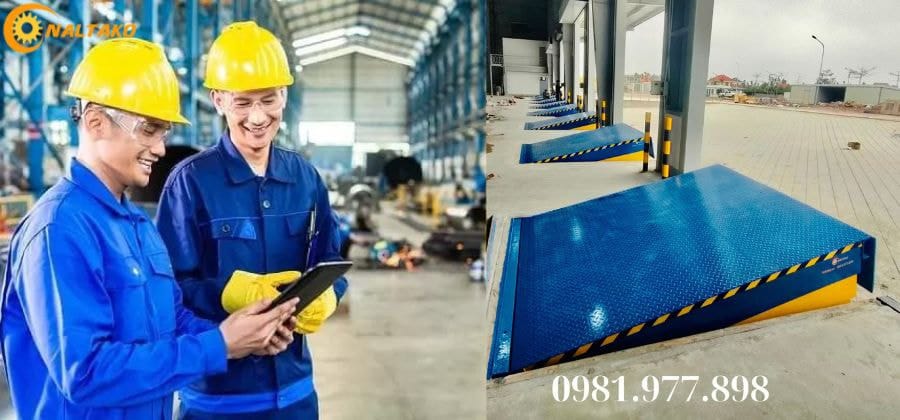
Additionally, inspection ensures the lift platform operates stably, enhances productivity, and ensures compliance with occupational safety laws.
Without inspection, businesses may face various risks such as labor accidents, production disruptions, property damage, and legal violations.
Damaged lift platforms can cause serious accidents, disrupt production processes, and lead to economic and reputational damage.
Inspection Validity Period for Hydraulic Lift Platforms
According to current regulations, the periodic inspection cycle for dock levelers must not exceed 2 years. However, for equipment that has been in operation for over 10 years, the inspection frequency is adjusted to once a year to ensure operational safety.
In cases where the manufacturer or the operator requests a shorter inspection cycle, the inspection will be conducted according to that request, with detailed reasons specified in the inspection report.
For lift platforms falling under the scope of current National Technical Regulations, compliance with the inspection deadlines as prescribed by the regulations is mandatory.
Hydraulic Dock Leveler Inspection Standards
Vietnamese Standards
- Circular No. 36/2019/TT-BLDTBXH: List of machinery, equipment, materials, and substances with strict requirements for occupational safety. Dock levelers fall under the lifting equipment group in this list.
- QCVN 22:2010/BGTVT: Technical regulation on manufacturing and inspection of loading and unloading vehicles and equipment.
- QTKĐ 11:2016/BLDTBXH: Inspection procedure for technical safety of lift tables and lift platforms in general.
- TCVN 4244:2005: Standard for lifting appliances—Design, manufacture, and technical inspection.
- TCVN 5206:1990: Standard for lifting machines—Safety requirements for counterweights and stabilizers.
- TCVN 5207:1990: Standard for lifting machines—General safety requirements.
- TCVN 5209:1990: Standard for lifting machines—Safety requirements for electrical equipment.
- TCVN 5179:90: Standard for lifting machines—Hydraulic safety testing requirements.
- TCVN 9358:2012: Standard for earthing system installation for industrial works—General requirements.
International Standards:
BS EN 1570:1998: Safety requirements for lifting tables and platforms.
Inspection Support Equipment for Dock Levelers
Support equipment for lift platform inspection must also meet quality and safety standards to ensure the accuracy of inspection results. Essential support tools include:
- Leveling instrument: To check the flatness and balance of the lift platform.
- Tachometer: To measure the lifting and lowering speed of the platform.
- Laser distance meter: To accurately measure dimensions and distances between platform components.
- Vernier calipers, tape measures: To check the geometric dimensions of details.
- Inspection load set: To test the load-bearing capacity of the lift platform.
- Insulation resistance/grounding tester: To check the electrical system of the lift platform.
- Multimeter: To measure voltage, current, and other electrical parameters.
- Clamp meter: To measure current in electrical circuits.
Reference:
- What is a pit? Standards and dimensions for dock leveler pits
- Dock Shelter and Dock Leveler: The perfect combination for warehouses
- What is an Automatic Dock Leveler? Advantages & Classification
- What are Dock Leveler Seals? Popular types of warehouse door seals
- What is a Mechanical Dock Leveler? How is it different from a Hydraulic Dock Leveler?
Cargo Lift Platform Inspection Procedure
Preparation
- The inspection organization and the user facility agree on the inspection plan.
- Fully prepare conditions to serve the inspection activities.
- Assign personnel to participate in and witness the inspection process.

Technical Documentation Review
- Review technical drawings and equipment history files.
- Check operation, maintenance, and repair logs, as well as previous inspection records.
External Inspection
- Inspect the installation site, electrical system, instruction signs, protective fences, and safety measures.
- Check the conformity of parts, details, and technical parameters against the documentation.
- Inspect metal structures, welds, joints, pulleys, shafts, cables, and fixed components.
- Inspect the hydraulic system (cylinders, piping) for deformation or oil leaks.
- Evaluate grounding and insulation resistance measurement reports.
- Check all safety and protective mechanisms.
Technical Testing
- No-load test: Check lifting operations, safety devices, brakes, stoppers, drive system, and controls.
- Static load test: Test at 125% of the Safe Working Load (SWL), at a lift height less than or equal to 200mm from the lowest position, maintained for 10 minutes.
- Dynamic load test: Test at 110% of SWL throughout the entire operational stroke.
- Perform each test content at least 3 times.
Processing Inspection Results
- Prepare the inspection report and record results in the equipment history file.
- Affix the inspection stamp if technical safety requirements are met.
- Issue a Certificate of Inspection Results if requirements are met.
- Request corrective actions or repairs if requirements are not met.
Dock Leveler Inspection Costs
The cost for cargo lift platform inspection is calculated based on the Safe Working Load (SWL) of the equipment, as regulated in Circular 41/2016/TT-BLDTBXH. Below is a reference price list:
| Safe Working Load (SWL) |
Minimum Fee (VNĐ)
|
| Under 1 ton | 1,500,000 |
| From 1 ton to under 3 tons | 2,000,000 |
| From 3 tons to under 5 tons | 2,500,000 |
| From 5 tons to under 10 tons | 3,000,000 |
| From 10 tons to under 20 tons | 4,000,000 |
| From 20 tons and above | 5,000,000 |
Where to Inspect Lift Platforms?
Some reputable dock leveler inspection units in Vietnam:
- Center for Industrial Safety Registration (under the Ministry of Labour, Invalids and Social Affairs)
- Vinacontrol
- SGS Vietnam
- Bureau Veritas Vietnam
Conclusion
Dock leveler inspection is a vital process to ensure occupational safety and compliance with legal regulations. We hope the above article by Naltako helps you feel confident about the quality and safety of your equipment, while enhancing operational efficiency and minimizing accident risks.
Nội dung có liên quan:
-
 What are Dock Leveler Seals? Popular types of warehouse dock shelters
Does the gap between the warehouse floor and the truck during the loading process affect the temperature inside the warehouse? Can factors like dust and in...
What are Dock Leveler Seals? Popular types of warehouse dock shelters
Does the gap between the warehouse floor and the truck during the loading process affect the temperature inside the warehouse? Can factors like dust and in...
-
 What is an Automatic Dock Leveler? Advantages & Classification
The process of loading and unloading goods between warehouses and trucks often faces many difficulties due to the height difference between the two floor s...
What is an Automatic Dock Leveler? Advantages & Classification
The process of loading and unloading goods between warehouses and trucks often faces many difficulties due to the height difference between the two floor s...
-
 Leading Causes of Forklift Accidents and How to Prevent Them
According to statistics from the Department of Occupational Safety, Vietnam records hundreds of forklift-related accidents every year, causing heavy damage...
Leading Causes of Forklift Accidents and How to Prevent Them
According to statistics from the Department of Occupational Safety, Vietnam records hundreds of forklift-related accidents every year, causing heavy damage...
-
 Should You Buy a Used Container Loading Ramp? Tips & Reputable Sellers
Buying a used container loading ramp can be a significant cost-saving solution for businesses, especially small and medium-sized enterprises. However, this...
Should You Buy a Used Container Loading Ramp? Tips & Reputable Sellers
Buying a used container loading ramp can be a significant cost-saving solution for businesses, especially small and medium-sized enterprises. However, this...
-
 Understanding the Structure of a 300kg Hydraulic Lift Table
Do you want to better understand the operating principle and structure of a 300kg hydraulic lift table? This article will answer all your questions, helpin...
Understanding the Structure of a 300kg Hydraulic Lift Table
Do you want to better understand the operating principle and structure of a 300kg hydraulic lift table? This article will answer all your questions, helpin...
-
 Where to Buy Used Hydraulic Lift Tables? Pricing Guide
Have you considered buying a used hydraulic lift table but don't know where to find a reputable supplier? Don't worry! This article will help you solve you...
Where to Buy Used Hydraulic Lift Tables? Pricing Guide
Have you considered buying a used hydraulic lift table but don't know where to find a reputable supplier? Don't worry! This article will help you solve you...
-
 Operating Principle of Hydraulic Freight Elevators
Have you ever wondered how hydraulic freight elevators can lift heavy loads smoothly and safely? The secret lies in its operating principle. In this articl...
Operating Principle of Hydraulic Freight Elevators
Have you ever wondered how hydraulic freight elevators can lift heavy loads smoothly and safely? The secret lies in its operating principle. In this articl...
-
 Should You Choose a Hydraulic Freight Elevator or a Motor Hoist Elevator?
Choosing between a hydraulic freight elevator and a motor hoist elevator is not simple. Each type has its own advantages and disadvantages, suitable for di...
Should You Choose a Hydraulic Freight Elevator or a Motor Hoist Elevator?
Choosing between a hydraulic freight elevator and a motor hoist elevator is not simple. Each type has its own advantages and disadvantages, suitable for di...