

 Tiếng Việt
Detailed Guide on How to Calculate Cold Storage Capacity
To operate a cold storage system effectively, calculating cold storage capacity is a key factor. Cold storage capacity not only affects cooling ability but also directly impacts investment and operational costs. In this article, Naltako will provide an overview of the cold storage system, reasons why accurate capacity calculation is needed, and detailed instructions on how to do this.
What equipment does a cold storage system consist of?
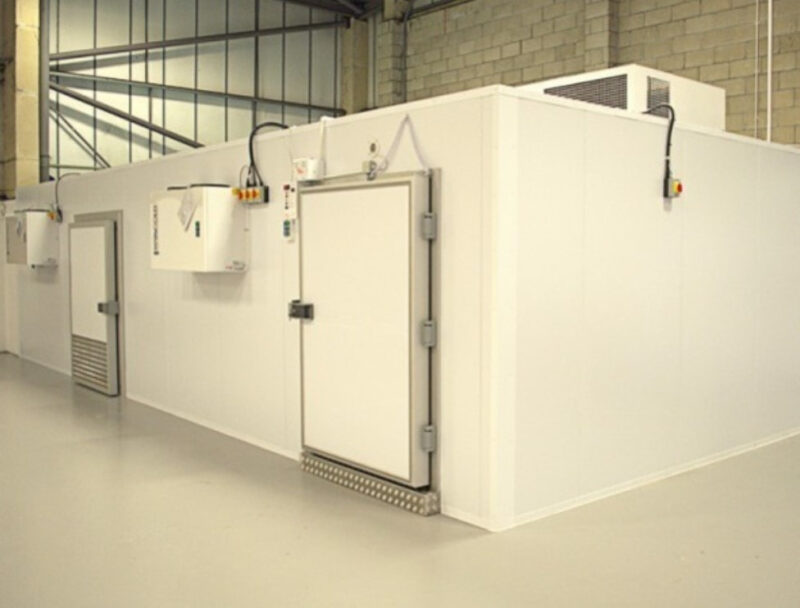
A complete cold storage system includes many devices and parts operating synchronously, ensuring the preservation environment always meets standards. Main equipment includes:
Cold storage shell (panels)
Usually made from PU or EPS panels, having good thermal insulation ability, preventing heat loss to the outside environment.
Compressor unit
The compressor unit is tasked with compressing the refrigerant to create low temperatures. The compressor unit can be a Piston, Scroll, or Screw compressor, depending on capacity and warehouse scale.
Indoor unit (evaporator)
Placed inside the warehouse, tasked with absorbing heat from the air inside the warehouse to cool the space.
Control electrical cabinet
Tasked with controlling and monitoring the entire operation of the cold storage, including temperature, pressure, and other operating modes.
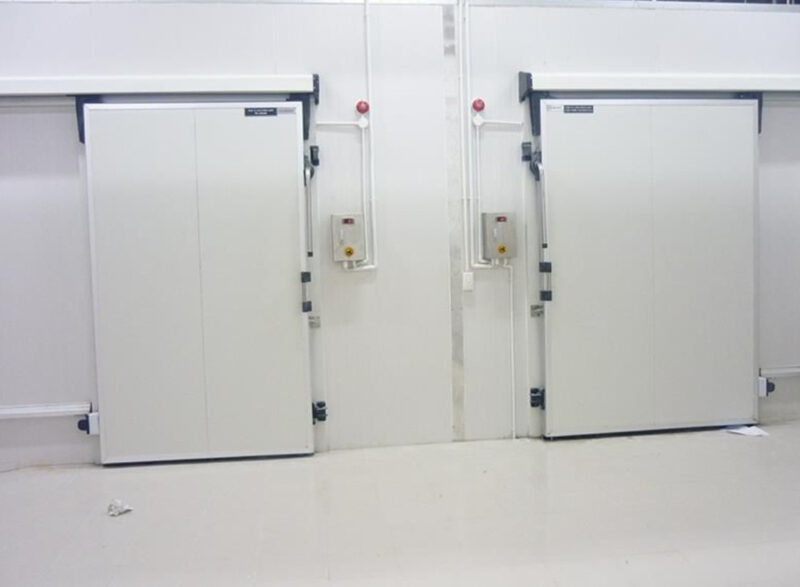
Cold storage door
Usually sliding doors or hinged doors, specially designed for good thermal insulation.
Safety system
Includes alarm bells, lighting systems, and safety sensors.
>>> What is warehousing? Should you rent a warehouse or self-manage?
Why should you calculate cold storage capacity?
Calculating cold storage capacity accurately is extremely important for the following reasons:
- Save investment costs: If you overestimate capacity, you will have to invest in a system larger than necessary, causing waste. Conversely, if capacity is insufficient, the system will have to operate continuously, overload, fail to reach the desired temperature, and have a high risk of damage.
- Optimize performance: A system with suitable capacity will operate stably, effectively, save electricity, and extend equipment lifespan.
- Ensure product quality: Accurate capacity helps maintain stable temperatures, ensuring preserved product quality is always in the best state.
- Effective logistics planning: Capacity calculation also helps businesses plan goods import and export reasonably. When combined with modern equipment like dock levelers, this process will take place quickly and safely, minimizing warehouse door opening time, helping maintain stable temperatures.
Detailed guide to calculating cold storage capacity
To calculate cold storage capacity, you need to consider the following heat load factors:
- Heat load from the shell: Amount of heat penetrating through the walls, ceiling, and floor of the cold storage.
- Heat load from products: Heat amount products bring into the warehouse, especially when products have not been cooled yet.
- Heat load from people and equipment: Heat emitted from workers, lighting, electric forklifts, fans…
- Heat load due to door opening: Amount of heat intruding into the warehouse when the door is opened. This is an important factor, especially for warehouses with high import/export frequency.
Cold storage capacity calculation formula: Required cooling capacity (BTU/h) = Heat load from shell + Heat load from products + Heat load from people & equipment + Heat load due to door opening. Where:
- Heat load from the shell: Depends on shell area and heat transfer coefficient of insulation material.
- Heat load from products: Depends on product mass entering the warehouse daily, initial temperature, storage temperature, and specific heat of the product.
- Heat load from people and equipment: Can be calculated based on the number of people and equipment capacity operating in the warehouse.
- Heat load due to door opening: Depends on door size, opening time, and opening frequency.
After calculating the total heat load, you should add a safety factor of 10% to 20% to ensure the system can operate effectively under all conditions.
Conclusion
Calculating cold storage capacity is an indispensable step to build an effective, economical, and sustainable preservation system. Investing in a system with suitable capacity not only helps you optimize costs but also ensures product quality and improves operational productivity. Naltako is proud to be a provider of comprehensive cold storage and logistics solutions, accompanying you on the path of sustainable development.
Nội dung có liên quan:
-
 Should You Use a Mini Hydraulic Lift Table?
A lift table is a very useful device for warehouses and workshops. They are used to transport goods as quickly as possible. Among the many types of lift ta...
Should You Use a Mini Hydraulic Lift Table?
A lift table is a very useful device for warehouses and workshops. They are used to transport goods as quickly as possible. Among the many types of lift ta...
-
 Choosing Between Hydraulic Dock Levelers or Forklift Ramps for Cargo Handling?
Currently in Vietnam, businesses are applying many different methods to carry out import and export operations. Some businesses continue to follow traditio...
Choosing Between Hydraulic Dock Levelers or Forklift Ramps for Cargo Handling?
Currently in Vietnam, businesses are applying many different methods to carry out import and export operations. Some businesses continue to follow traditio...
-
 What is a Loading Dock? What does a Loading Dock system include?
Is your business facing difficulties in transporting goods? Is loading and unloading taking too much time and increasing costs? Have you researched solutio...
What is a Loading Dock? What does a Loading Dock system include?
Is your business facing difficulties in transporting goods? Is loading and unloading taking too much time and increasing costs? Have you researched solutio...
-
 Hydraulic Cylinder Structure, Specifications, and Operating Principles
Hydraulic cylinders, also known as hydraulic rams, are one of the most critical components in a hydraulic system. They have the ability to convert hydrauli...
Hydraulic Cylinder Structure, Specifications, and Operating Principles
Hydraulic cylinders, also known as hydraulic rams, are one of the most critical components in a hydraulic system. They have the ability to convert hydrauli...
-
 Differences Between Freight Elevators and Goods Hoists
Choosing between a freight elevator and a goods hoist is always a difficult puzzle for many businesses. Understanding this, Naltako will help you solve the...
Differences Between Freight Elevators and Goods Hoists
Choosing between a freight elevator and a goods hoist is always a difficult puzzle for many businesses. Understanding this, Naltako will help you solve the...
-
 Hydraulics: Concept, Structure, and Basic Operating Principles
Hydraulics is a vital technology, widely used in modern life. From industrial machinery like dock levelers to vehicles, this system plays an indispensable ...
Hydraulics: Concept, Structure, and Basic Operating Principles
Hydraulics is a vital technology, widely used in modern life. From industrial machinery like dock levelers to vehicles, this system plays an indispensable ...
-
 Dock Shelter and Dock Leveler: The Perfect Combination for Your Warehouse
Is your warehouse operating inefficiently, with high risks of cargo damage and low productivity? Don't worry, the optimal solution is here! The combination...
Dock Shelter and Dock Leveler: The Perfect Combination for Your Warehouse
Is your warehouse operating inefficiently, with high risks of cargo damage and low productivity? Don't worry, the optimal solution is here! The combination...
-
 What is a Raised Floor? What are the components of its structure?
Raised floors, hydraulic dock levelers, and access floors are popular types of flooring widely used in modern construction engineering today. To learn deta...
What is a Raised Floor? What are the components of its structure?
Raised floors, hydraulic dock levelers, and access floors are popular types of flooring widely used in modern construction engineering today. To learn deta...