

 Tiếng Việt
Operating Principle of Hydraulic Freight Elevators
Have you ever wondered how hydraulic freight elevators can lift heavy loads smoothly and safely? The secret lies in its operating principle. In this article, we will explore in detail the operating principle of hydraulic freight elevators, helping you better understand this essential equipment in the industrial sector.
Introduction to Hydraulic Freight Elevators
A hydraulic freight elevator is a specialized device used to lift and lower goods between different floors or heights. The elevator utilizes the power of hydraulic fluid to generate lifting force.
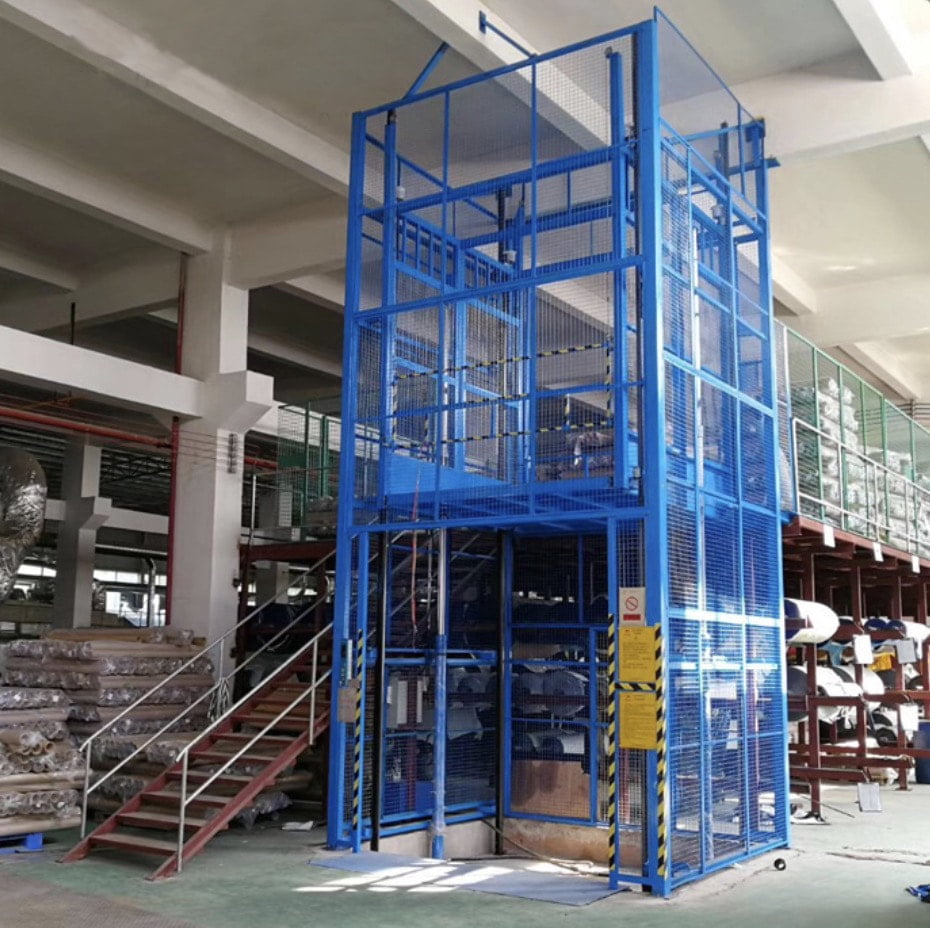
They are widely used in warehouses, factories, distribution centers, and other industrial facilities to transport goods efficiently and safely.
Check out the article below to learn more about the product:
Operating Principle of Hydraulic Freight Elevators
Pascal’s Law
According to the concept of Pascal’s Law: Pressure applied to a confined fluid is transmitted undiminished in every direction.
This means that when we apply a small force to a small area of the fluid, this force will be amplified and transmitted throughout the system, creating a larger force over a larger area.
Hydraulic System
Hydraulic Pump: This is the heart of the system, responsible for suctioning hydraulic oil from the reservoir and pushing it into the system under high pressure.
Control Valve: The control valve acts as the brain of the system, regulating the direction and flow of hydraulic oil to control the elevator’s movement.
Video simulating the operating principle of a hydraulic freight elevator
Hydraulic Cylinder: The hydraulic cylinder is where hydraulic pressure is converted into lifting force. When hydraulic oil is pumped into the cylinder, it pushes the piston upward, lifting the platform and the goods.
Find out the difference between freight elevators and goods hoists: Here
The Lifting and Lowering Process
Lifting Operation: When the operator activates the lift, the hydraulic pump starts working, pushing hydraulic oil into the cylinder. As oil pressure increases, it pushes the piston in the cylinder upward, carrying the lifting platform and goods along.
Holding Operation: When the platform reaches the desired height, the control valve closes, preventing hydraulic oil from flowing out of the cylinder. As a result, the platform and goods are held firmly in that position.
Lowering Operation: To lower the platform, the control valve opens, allowing the hydraulic oil to flow back into the reservoir. The weight of the platform and goods pushes the piston downward, returning the platform to its original position.
Thanks to the harmonious combination of these components and Pascal’s principle, hydraulic freight elevators can lift heavy volumes easily and safely, playing a vital role in many industries.
See more:
Conclusion
Understanding the operating principle of hydraulic freight elevators ensures that the equipment is operated and maintained safely and effectively.
With outstanding advantages in power, stability, and flexibility, hydraulic freight elevators continue to affirm their indispensable role in improving productivity and optimizing workflows in modern industries.
Nội dung có liên quan:
-
 What are Dock Leveler Seals? Popular types of warehouse dock shelters
Does the gap between the warehouse floor and the truck during the loading process affect the temperature inside the warehouse? Can factors like dust and in...
What are Dock Leveler Seals? Popular types of warehouse dock shelters
Does the gap between the warehouse floor and the truck during the loading process affect the temperature inside the warehouse? Can factors like dust and in...
-
 What is an Automatic Dock Leveler? Advantages & Classification
The process of loading and unloading goods between warehouses and trucks often faces many difficulties due to the height difference between the two floor s...
What is an Automatic Dock Leveler? Advantages & Classification
The process of loading and unloading goods between warehouses and trucks often faces many difficulties due to the height difference between the two floor s...
-
 Leading Causes of Forklift Accidents and How to Prevent Them
According to statistics from the Department of Occupational Safety, Vietnam records hundreds of forklift-related accidents every year, causing heavy damage...
Leading Causes of Forklift Accidents and How to Prevent Them
According to statistics from the Department of Occupational Safety, Vietnam records hundreds of forklift-related accidents every year, causing heavy damage...
-
 Should You Buy a Used Container Loading Ramp? Tips & Reputable Sellers
Buying a used container loading ramp can be a significant cost-saving solution for businesses, especially small and medium-sized enterprises. However, this...
Should You Buy a Used Container Loading Ramp? Tips & Reputable Sellers
Buying a used container loading ramp can be a significant cost-saving solution for businesses, especially small and medium-sized enterprises. However, this...
-
 Understanding the Structure of a 300kg Hydraulic Lift Table
Do you want to better understand the operating principle and structure of a 300kg hydraulic lift table? This article will answer all your questions, helpin...
Understanding the Structure of a 300kg Hydraulic Lift Table
Do you want to better understand the operating principle and structure of a 300kg hydraulic lift table? This article will answer all your questions, helpin...
-
 Where to Buy Used Hydraulic Lift Tables? Pricing Guide
Have you considered buying a used hydraulic lift table but don't know where to find a reputable supplier? Don't worry! This article will help you solve you...
Where to Buy Used Hydraulic Lift Tables? Pricing Guide
Have you considered buying a used hydraulic lift table but don't know where to find a reputable supplier? Don't worry! This article will help you solve you...
-
 Should You Choose a Hydraulic Freight Elevator or a Motor Hoist Elevator?
Choosing between a hydraulic freight elevator and a motor hoist elevator is not simple. Each type has its own advantages and disadvantages, suitable for di...
Should You Choose a Hydraulic Freight Elevator or a Motor Hoist Elevator?
Choosing between a hydraulic freight elevator and a motor hoist elevator is not simple. Each type has its own advantages and disadvantages, suitable for di...
-
 Standards and Procedures for Dock Leveler Inspection
The Importance of Dock Leveler Inspection
Periodic inspection of dock levelers plays a key role in ensuring occupational safety, optimizing operational pe...
Standards and Procedures for Dock Leveler Inspection
The Importance of Dock Leveler Inspection
Periodic inspection of dock levelers plays a key role in ensuring occupational safety, optimizing operational pe...