

 Tiếng Việt
What is load-bearing steel? Applications in forklift ramp production
Load-bearing steel is one of the indispensable materials in modern construction and industrial projects. With the ability to withstand heavy loads, load-bearing steel plays a crucial role in ensuring the durability and safety of structures. In Vietnam, the demand for load-bearing steel is increasing, especially in factories, bridges, and high-rise buildings. In this article, we will explore load-bearing steel in detail and its application in the production of forklift ramps.
What is Load-Bearing Steel? Understanding the Basic Concept
Load-bearing steel, also known as high-strength steel or structural steel, is a type of steel specifically designed to withstand heavy loads in construction and industrial projects. With superior load-bearing capacity, this material helps ensure the stability of load-bearing steel structures such as building frames, columns, beams, or floors. The outstanding characteristics of load-bearing steel lie in its high tensile strength, resistance to deformation, and design flexibility, allowing for the creation of diverse construction projects while still ensuring safety.

The role of load-bearing steel goes beyond reinforcing structures; it also contributes to reducing the overall weight of the project, saving costs and construction time. According to construction standards such as TCVN Standards, load-bearing steel must meet strict requirements for quality and technical specifications to ensure long-term durability. In practice, projects using load-bearing steel often come with the need to transport and install heavy materials, requiring specialized support equipment. This is when modern lifting solutions become essential, helping to optimize the construction process and ensure occupational safety.
>>> What is Q345 steel? Applications of Q345 steel in industry
Common Types of Load-Bearing Steel
There are many different types of load-bearing steel, each possessing unique characteristics suitable for specific purposes in construction and industry. Below are the common types of load-bearing steel you should know, including H-beams, load-bearing steel pipes, load-bearing steel plates, rebar, and prestressed steel.
H-Beam Steel
This is a type of steel with an H-shaped cross-section, notable for its high load-bearing capacity and good bending resistance. This type of steel is often used in the steel frame systems of high-rise buildings and bridges thanks to its high tensile strength limit.
Load-Bearing Steel Pipes
With circular or square shapes, steel pipes are applied in column structures, roof trusses, or factory frames. This type of steel is lightweight but still ensures impressive tensile strength.
Load-Bearing Steel Plates
Steel plates are widely used in the mechanical and construction industries, especially for flooring or components under high pressure. According to research sources, steel plates such as A516 have superior heat and pressure resistance, suitable for heavy industrial equipment.
Rebar (Reinforcing Bar)
This type of steel is commonly used in reinforced concrete structures, helping to enhance the tensile strength of floors, foundations, and columns. The ribbed surface helps increase adhesion with concrete.
Prestressed Steel
Applied in large projects such as cable-stayed bridges or high-rise buildings, prestressed steel helps increase the load-bearing capacity of steel and extends the lifespan of the project through pre-tensioning techniques before pouring concrete.
Each type of steel has its own load-bearing features, meeting requirements for load-bearing steel dimensions and specific applications. Choosing the right type of steel not only ensures safety but also optimizes costs for the project. If you are looking for construction support equipment for projects using load-bearing steel, Naltako is ready to accompany you with products such as freight elevators and mini cranes. Contact us now for the most suitable solution!
Applications of Load-Bearing Steel in Industrial Factories
One of the most important applications of load-bearing steel is in industrial factories. Load-bearing steel, especially construction steel and structural steel, is used to create sturdy steel frames, ensuring the ability to withstand heavy loads from machinery, goods, and production activities. Load-bearing steel structures such as beams, columns, and steel trusses help factories have spacious areas, making them easy to expand while maintaining durability over time.
In factory projects, load-bearing steel not only plays a reinforcing role but also helps reduce construction costs thanks to its lightweight and high flexibility. According to studies, steel frame systems are commonly applied in pre-engineered buildings, warehouses, and enterprises, bringing outstanding economic efficiency. However, the installation and transportation of heavy steel components require support from specialized lifting equipment to ensure safety and construction progress.
Naltako is proud to provide optimal solutions for projects using load-bearing steel with products such as hydraulic lift tables and forklift ramps, helping to transport and install materials easily. If you are looking for suitable equipment for your project, please contact us via email info@naltako.vn for a detailed quote and free consultation.
Application of Load-Bearing Steel in Forklift Ramp Production
In the manufacturing of forklift ramps (also known as container ramps), load-bearing steel plays an extremely important role as the core material that determines the durability, safety, and load capacity of the entire equipment. The application of load-bearing steel in forklift ramps is clearly demonstrated through the following aspects:
Ensuring Extremely Large Load Capacity
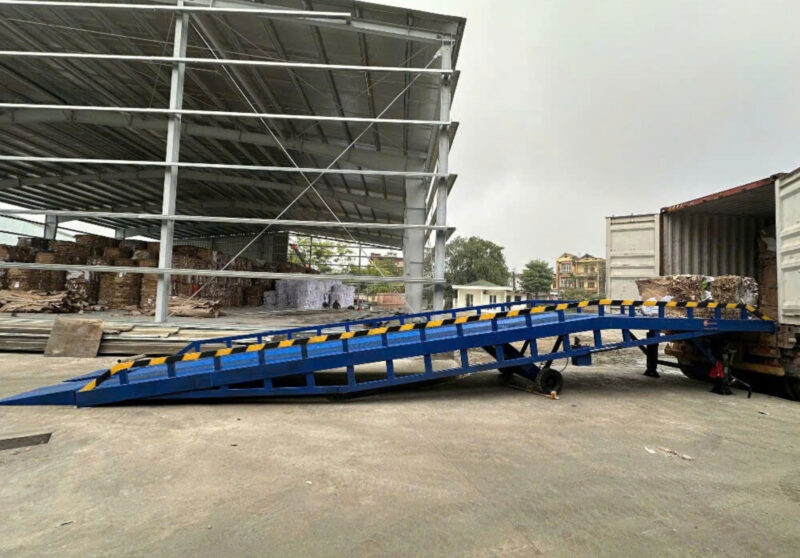
- Static and dynamic load bearing: Forklift ramps must withstand very large loads from the forklift itself (usually 3-7 tons), plus the weight of the goods the forklift is carrying (which can be up to dozens of tons). Load-bearing steel, with high tensile and yield strength, ensures the ramp does not deform, warp, or collapse under this pressure.
- Concentrated force bearing: When forklift wheels move on the ramp, the impact force will concentrate on small points. Load-bearing steel has the ability to disperse and withstand these concentrated forces without cracking.
Creating Sturdy and Stable Structures
- Main beam frame: The main beams of the ramp (usually I-beams or large U-shaped steel) are the primary load-bearing parts, supporting the entire weight. The use of load-bearing steel ensures the beam frame has enough rigidity, without shaking or losing stability when the forklift moves.
- Torsion and bending structures: The ramp must withstand both bending and torsion forces as the forklift moves up and down. Load-bearing steel with good mechanical properties helps the ramp maintain its original shape and avoid damage.
Enhancing Operational Safety
- Anti-slip floor surface: In addition to the load-bearing structure, the ramp’s floor surface is often made of checkered steel plates or grating. This is also a form of load-bearing steel specially processed to increase grip for forklift wheels, effectively preventing slips, especially in wet or oily conditions.
- Long-term durability: Load-bearing steel has better wear and corrosion resistance than ordinary steel when properly surface-treated. This extends the life of the ramp and minimizes the risk of failure during continuous use.
Allowing for Optimized Design
- Reducing overall weight: With high strength-to-weight ratios, manufacturers can use load-bearing steel to reduce the amount of material needed while still ensuring durability, giving the ramp an optimized weight for easier movement (for mobile ramps) and installation.
- Flexible customization: Load-bearing steel is easily cut, welded, and bent to create ramp designs with diverse sizes, heights, and load capacities, meeting the specific needs of each warehouse or type of truck/container.
Conclusion
Load-bearing steel plays an indispensable role in the modern construction industry and many other industrial fields. With its ability to withstand extremely heavy loads, superior durability, and design flexibility, load-bearing steel has become the core material in forklift ramp production. We hope that with the information provided by Naltako, you have gained a better understanding of load-bearing steel and its applications.
Nội dung có liên quan:
-
 The Uses of Dock Levelers in Today’s Cold Storage Facilities
To ensure the operational efficiency of cold storage, selecting and using the correct support equipment is extremely important. One of the indispensable so...
The Uses of Dock Levelers in Today’s Cold Storage Facilities
To ensure the operational efficiency of cold storage, selecting and using the correct support equipment is extremely important. One of the indispensable so...
-
 Applications of Hydraulic Dock Levelers
Hydraulic Dock Leveler is a connecting device between the container floor and the warehouse floor, widely used in warehouses with high import and export fr...
Applications of Hydraulic Dock Levelers
Hydraulic Dock Leveler is a connecting device between the container floor and the warehouse floor, widely used in warehouses with high import and export fr...
-
 Why Are Forklift Ramps the Preferred Choice for Import and Export Operations?
Container loading ramps bring many important benefits to transport and cargo handling operations. Specially designed, container forklift ramps not only hel...
Why Are Forklift Ramps the Preferred Choice for Import and Export Operations?
Container loading ramps bring many important benefits to transport and cargo handling operations. Specially designed, container forklift ramps not only hel...
-
 Popular Forklift Ramp Models with Roofs in Use Today
Currently, forklift ramps with roofs have quickly attracted the attention of small and medium-sized enterprises. Not only are they a convenient means of tr...
Popular Forklift Ramp Models with Roofs in Use Today
Currently, forklift ramps with roofs have quickly attracted the attention of small and medium-sized enterprises. Not only are they a convenient means of tr...
-
 The Most Widely Used Cargo Handling Support Tools Today
There are many different tools available to support cargo loading and unloading, each with its own advantages and disadvantages. Users need to research and...
The Most Widely Used Cargo Handling Support Tools Today
There are many different tools available to support cargo loading and unloading, each with its own advantages and disadvantages. Users need to research and...
-
 What is a Loading Ramp? Applications of Ramps in Goods Transportation
What is a Loading Ramp?
A loading ramp, also known as a yard ramp or forklift ramp, is a powerful support device in the transportation of goods.
Essentia...
What is a Loading Ramp? Applications of Ramps in Goods Transportation
What is a Loading Ramp?
A loading ramp, also known as a yard ramp or forklift ramp, is a powerful support device in the transportation of goods.
Essentia...
-
 What is a scissor mechanism? Applications of scissor mechanisms in hydraulic lifting equipment
Today, scissor mechanisms are widely applied in hydraulic lifting equipment. These applications are extensively used in construction projects and bring hig...
What is a scissor mechanism? Applications of scissor mechanisms in hydraulic lifting equipment
Today, scissor mechanisms are widely applied in hydraulic lifting equipment. These applications are extensively used in construction projects and bring hig...
-
 Applications of dock levelers in production
A Dock Leveler is not just a bridge between the warehouse and the transport vehicle, but also a powerful assistant that helps you operate your production p...
Applications of dock levelers in production
A Dock Leveler is not just a bridge between the warehouse and the transport vehicle, but also a powerful assistant that helps you operate your production p...