

 Tiếng Việt
What is a truck tail lift? Some information about truck tail lifts
A truck tail lift is a device that helps support the process of lifting and lowering goods from trucks faster, safer, and more effectively than ever before. Let’s explore truck tail lifts, from detailed structure and classification to reference prices, to help you better understand this equipment and make the right investment decision for your business.
What is a truck tail lift?
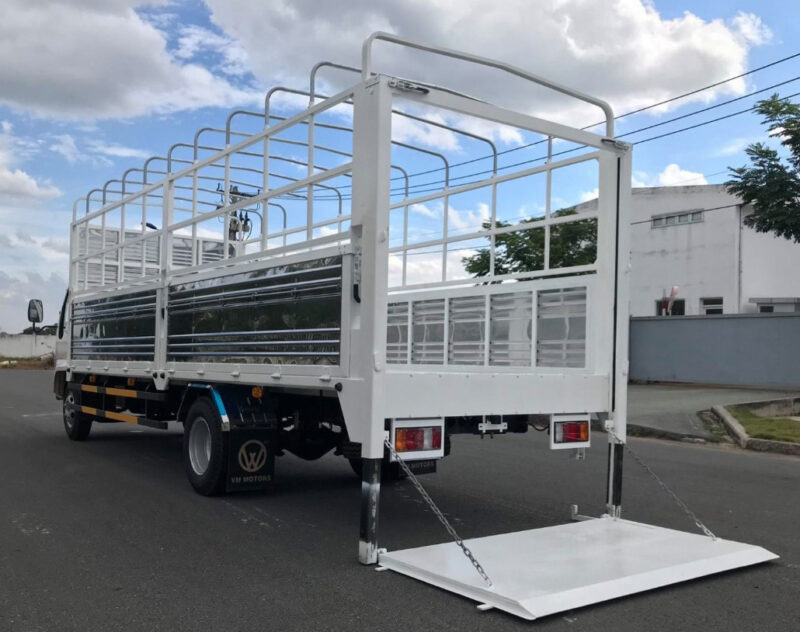
Unlike mobile hydraulic dock levelers, a truck tail lift (English: Tail Lift or Cargo Lift) is a mechanical device installed at the rear of the truck box. This device functions to lift and lower goods from the ground to the truck box or vice versa, via a powerful hydraulic system. The tail lift operates similarly to a small elevator, helping to significantly save labor and time, and minimize the risk of cargo damage during loading and unloading.
Equipping a truck tail lift not only helps increase work productivity but also demonstrates the professionalism of the business, bringing maximum safety to both employees and assets.
Structure of a truck tail lift
A complete truck tail lift has a fairly simple but extremely sturdy and effective structure, consisting of the following main parts:
Hydraulic system
This is the “heart” of the tail lift, including a hydraulic pump, hydraulic cylinders, and oil pipes. When the motor operates, the pump generates pressure to push oil into the cylinder, creating a powerful lifting force to raise the goods.
Lifting platform
It is the part that directly contacts and holds the goods. The lifting platform is usually made of load-bearing steel, anti-slip steel, or aluminum. The dimensions and material of the platform are designed to suit the load capacity and type of goods to be transported.
Frame and lifting arms
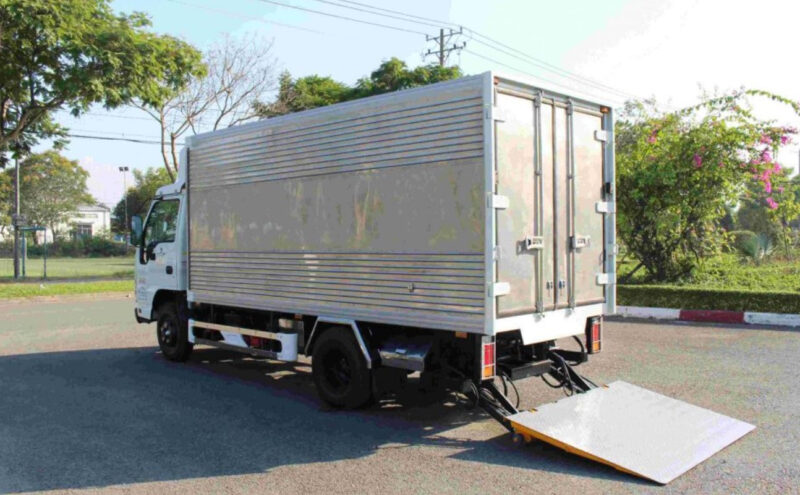
The frame is permanently attached to the truck chassis. The lifting arm is the connecting part between the platform and the frame, responsible for transmitting force from the hydraulic cylinder to raise and lower the platform.
Control system
This system includes up/down control buttons and safety valves. The operator can easily control the tail lift with just a few simple operations, ensuring precision and safety.
Safety lock system
To ensure absolute safety when the vehicle is moving, truck tail lifts are often equipped with mechanical lock latches or automatic locks, helping to fix the lifting platform to the vehicle frame.
Some common types of cargo tail lifts
On the market today, there are many types of tail lifts with different designs and operating mechanisms, suitable for each usage need:
- 4-cylinder tail lift: This is the most common type of tail lift, with 2 lifting cylinders and 2 tilting cylinders. This design helps the tail lift operate stably, balanced, and withstand loads well.
- 2-cylinder tail lift: This type has a simpler design, with only 2 lifting cylinders. 2-cylinder truck tail lifts are often used for light and medium-weight goods.
- Slider tail lift (Retractable): This is a specially designed tail lift that can slide under the chassis when not in use. This helps save space and does not affect the external shape of the truck.
- Fold-away tail lift: The tail lift can be folded neatly when not needed, very convenient for trucks with small boxes.
Choosing which type of truck tail lift depends on the weight of the goods, the size of the truck box, and the business’s budget.
How much does a truck tail lift cost?
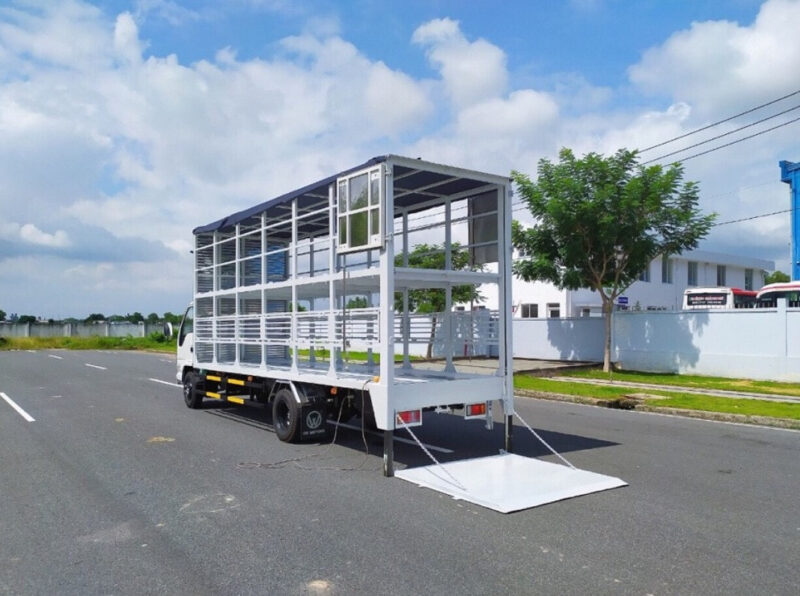
The price of truck tail lifts is not fixed but depends on many factors:
- Lifting capacity: The larger the lifting capacity (e.g., 500kg, 1 ton, 2 tons), the higher the cost.
- Type of tail lift: 4-cylinder tail lifts usually have a higher price than 2-cylinder tail lifts. Slider or fold-away tail lifts also have different prices depending on the complexity of the design.
- Platform material: Aluminum platforms usually cost more than steel platforms, but are lighter and more rust-resistant.
- Brand and origin: Tail lifts imported from reputable European brands usually cost more than products manufactured in Asia.
- Installation cost: Installation cost is also an important part of the total price.
In general, truck tail lift prices range from several tens to hundreds of millions of VND, depending on the configuration and specific requirements.
Conclusion
Truck tail lift is an effective investment device, bringing many practical benefits to transport businesses. Owning a truck tail lift not only helps optimize the cargo handling process but also ensures safety for employees and assets. With the diversity of types and prices on the market, you can completely find a solution that suits your needs.
Contact Naltako immediately for detailed and professional advice on truck tail lift types, helping you make the most optimal choice.
Nội dung có liên quan:
-
 Should You Use a Mini Hydraulic Lift Table?
A lift table is a very useful device for warehouses and workshops. They are used to transport goods as quickly as possible. Among the many types of lift ta...
Should You Use a Mini Hydraulic Lift Table?
A lift table is a very useful device for warehouses and workshops. They are used to transport goods as quickly as possible. Among the many types of lift ta...
-
 Choosing Between Hydraulic Dock Levelers or Forklift Ramps for Cargo Handling?
Currently in Vietnam, businesses are applying many different methods to carry out import and export operations. Some businesses continue to follow traditio...
Choosing Between Hydraulic Dock Levelers or Forklift Ramps for Cargo Handling?
Currently in Vietnam, businesses are applying many different methods to carry out import and export operations. Some businesses continue to follow traditio...
-
 What is a Loading Dock? What does a Loading Dock system include?
Is your business facing difficulties in transporting goods? Is loading and unloading taking too much time and increasing costs? Have you researched solutio...
What is a Loading Dock? What does a Loading Dock system include?
Is your business facing difficulties in transporting goods? Is loading and unloading taking too much time and increasing costs? Have you researched solutio...
-
 Hydraulic Cylinder Structure, Specifications, and Operating Principles
Hydraulic cylinders, also known as hydraulic rams, are one of the most critical components in a hydraulic system. They have the ability to convert hydrauli...
Hydraulic Cylinder Structure, Specifications, and Operating Principles
Hydraulic cylinders, also known as hydraulic rams, are one of the most critical components in a hydraulic system. They have the ability to convert hydrauli...
-
 Differences Between Freight Elevators and Goods Hoists
Choosing between a freight elevator and a goods hoist is always a difficult puzzle for many businesses. Understanding this, Naltako will help you solve the...
Differences Between Freight Elevators and Goods Hoists
Choosing between a freight elevator and a goods hoist is always a difficult puzzle for many businesses. Understanding this, Naltako will help you solve the...
-
 Hydraulics: Concept, Structure, and Basic Operating Principles
Hydraulics is a vital technology, widely used in modern life. From industrial machinery like dock levelers to vehicles, this system plays an indispensable ...
Hydraulics: Concept, Structure, and Basic Operating Principles
Hydraulics is a vital technology, widely used in modern life. From industrial machinery like dock levelers to vehicles, this system plays an indispensable ...
-
 Dock Shelter and Dock Leveler: The Perfect Combination for Your Warehouse
Is your warehouse operating inefficiently, with high risks of cargo damage and low productivity? Don't worry, the optimal solution is here! The combination...
Dock Shelter and Dock Leveler: The Perfect Combination for Your Warehouse
Is your warehouse operating inefficiently, with high risks of cargo damage and low productivity? Don't worry, the optimal solution is here! The combination...
-
 What is a Raised Floor? What are the components of its structure?
Raised floors, hydraulic dock levelers, and access floors are popular types of flooring widely used in modern construction engineering today. To learn deta...
What is a Raised Floor? What are the components of its structure?
Raised floors, hydraulic dock levelers, and access floors are popular types of flooring widely used in modern construction engineering today. To learn deta...