

 Tiếng Việt
Some notes when choosing container loading conveyors
The process of loading and unloading goods onto and off containers is one of the most costly and time-consuming stages. To optimize this process, liberate labor, and improve efficiency, container loading conveyor belts have become an indispensable solution. These types of conveyors not only help accelerate loading and unloading speeds but also ensure safety for goods and workers. In this article, Naltako will help you explore in detail popular conveyor types, important notes when choosing, and their role in the modern supply chain.
Some popular types of container loading conveyor belts
On the market today, there are many types of container loading conveyor belts, each with its own characteristics and advantages, suitable for specific usage needs:
Telescopic Conveyor
This is the most preferred type of conveyor due to its high flexibility. Its structure consists of multiple conveyor sections that can nest inside each other, allowing for easy extension or retraction, enabling the conveyor to reach deep inside the container. Telescopic conveyors can be roller conveyors (gravity or powered) or PVC belt conveyors.
Mobile Conveyor
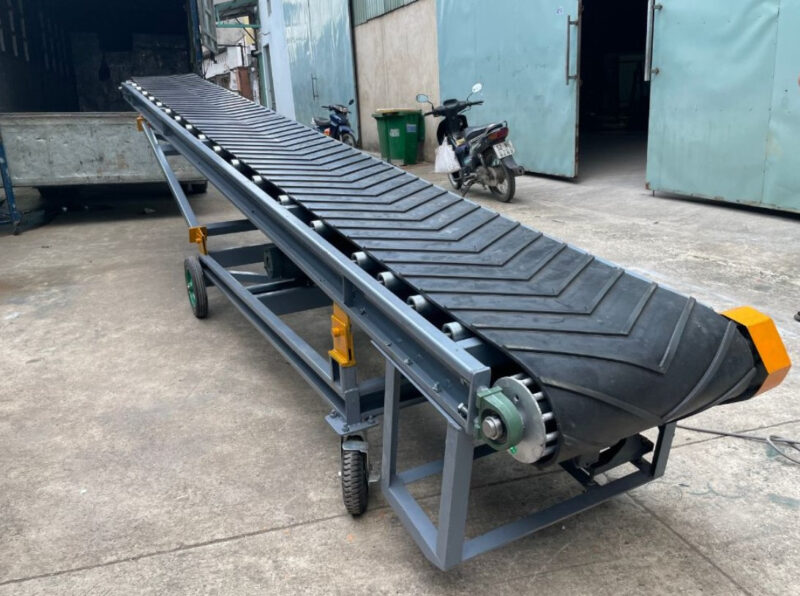
It is a type of conveyor with wheels, allowing for easy movement between different areas in the warehouse. This type of conveyor is often used in combination with fixed conveyors or to support loading and unloading in areas without fixed conveyors.
Inclined Conveyor
The angle of inclination can be adjusted, helping to load goods onto trucks or containers easily. This type of conveyor is suitable for transporting packaged goods such as cartons and packaging.
Spiral Conveyor
Used to move goods to higher levels in limited space. This type of conveyor is very suitable for multi-story warehouses or where space saving is needed.
What to keep in mind when choosing a container loading conveyor
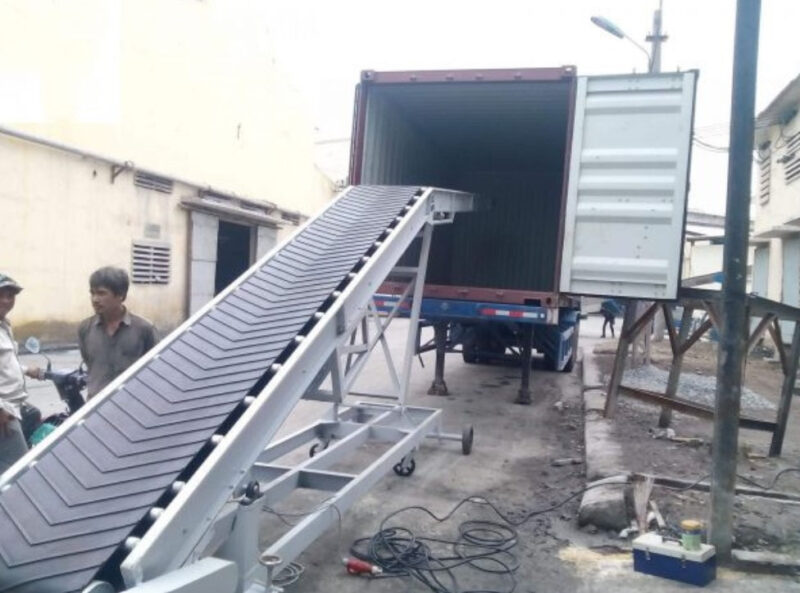
To choose the most suitable and effective type of vehicle loading conveyor, you need to consider the following factors:
- Type of goods: Depending on the type of goods (cartons, bags, packages…) you need to choose a conveyor with a suitable surface. For example, PVC conveyors are suitable for cartons, while rubber conveyors are better for heavy bags.
- Load capacity and speed: Determine the maximum load of the goods and the desired transport speed to select a conveyor with suitable capacity, avoiding overload or waste.
- Container and truck dimensions: The size of the conveyor must match the length and height of the container or truck box. Telescopic container loading conveyors are an ideal choice because they can be adjusted flexibly.
- Working environment: If the conveyor works in a wet environment or one with chemicals, you need to choose rust-resistant and corrosion-resistant materials.
- Integration capability: Choose a conveyor that can be easily integrated into the enterprise’s existing logistics system. For example, at the loading/unloading area, you can use equipment such as hydraulic lift tables to move goods from forklifts to the conveyor or vice versa, creating a closed, automated, and safe process.
- Supplier and after-sales service: Choose a reputable supplier with a clear warranty policy and good after-sales service. A professional supplier will advise you on the most optimal solution and provide quick technical support when needed.
>>> Heat resistant mesh conveyor belt: Classification & advantages
Conclusion
Investing in a quality container loading conveyor belt system is a strategic decision that helps businesses optimize logistics processes, save costs, and improve productivity. With a diversity of types and features, container loading conveyors have become a powerful “assistant”, contributing to the sustainable development of the industry. Naltako is proud to be a provider of comprehensive lifting and logistics solutions, accompanying you on the path of development and success.
Nội dung có liên quan:
-
 Should You Use a Mini Hydraulic Lift Table?
A lift table is a very useful device for warehouses and workshops. They are used to transport goods as quickly as possible. Among the many types of lift ta...
Should You Use a Mini Hydraulic Lift Table?
A lift table is a very useful device for warehouses and workshops. They are used to transport goods as quickly as possible. Among the many types of lift ta...
-
 Choosing Between Hydraulic Dock Levelers or Forklift Ramps for Cargo Handling?
Currently in Vietnam, businesses are applying many different methods to carry out import and export operations. Some businesses continue to follow traditio...
Choosing Between Hydraulic Dock Levelers or Forklift Ramps for Cargo Handling?
Currently in Vietnam, businesses are applying many different methods to carry out import and export operations. Some businesses continue to follow traditio...
-
 What is a Loading Dock? What does a Loading Dock system include?
Is your business facing difficulties in transporting goods? Is loading and unloading taking too much time and increasing costs? Have you researched solutio...
What is a Loading Dock? What does a Loading Dock system include?
Is your business facing difficulties in transporting goods? Is loading and unloading taking too much time and increasing costs? Have you researched solutio...
-
 Hydraulic Cylinder Structure, Specifications, and Operating Principles
Hydraulic cylinders, also known as hydraulic rams, are one of the most critical components in a hydraulic system. They have the ability to convert hydrauli...
Hydraulic Cylinder Structure, Specifications, and Operating Principles
Hydraulic cylinders, also known as hydraulic rams, are one of the most critical components in a hydraulic system. They have the ability to convert hydrauli...
-
 Differences Between Freight Elevators and Goods Hoists
Choosing between a freight elevator and a goods hoist is always a difficult puzzle for many businesses. Understanding this, Naltako will help you solve the...
Differences Between Freight Elevators and Goods Hoists
Choosing between a freight elevator and a goods hoist is always a difficult puzzle for many businesses. Understanding this, Naltako will help you solve the...
-
 Hydraulics: Concept, Structure, and Basic Operating Principles
Hydraulics is a vital technology, widely used in modern life. From industrial machinery like dock levelers to vehicles, this system plays an indispensable ...
Hydraulics: Concept, Structure, and Basic Operating Principles
Hydraulics is a vital technology, widely used in modern life. From industrial machinery like dock levelers to vehicles, this system plays an indispensable ...
-
 Dock Shelter and Dock Leveler: The Perfect Combination for Your Warehouse
Is your warehouse operating inefficiently, with high risks of cargo damage and low productivity? Don't worry, the optimal solution is here! The combination...
Dock Shelter and Dock Leveler: The Perfect Combination for Your Warehouse
Is your warehouse operating inefficiently, with high risks of cargo damage and low productivity? Don't worry, the optimal solution is here! The combination...
-
 What is a Raised Floor? What are the components of its structure?
Raised floors, hydraulic dock levelers, and access floors are popular types of flooring widely used in modern construction engineering today. To learn deta...
What is a Raised Floor? What are the components of its structure?
Raised floors, hydraulic dock levelers, and access floors are popular types of flooring widely used in modern construction engineering today. To learn deta...