

 Tiếng Việt
Hydraulic Pullers: Structure and Industrial Applications
Hydraulic pullers are indispensable tools in the mechanical industry, helping to disassemble bearings and gears powerfully and safely. At Naltako, we provide high-quality hydraulic pullers made from durable Cr-V steel, meeting the needs of automotive repair, industrial machinery maintenance, and equipment assembly. With large pulling force and a flexible design, this product is the optimal solution for disassembly work. Let’s explore the details of hydraulic pullers and solutions from Naltako in the article below.
What is a Hydraulic Puller and What Types are There?
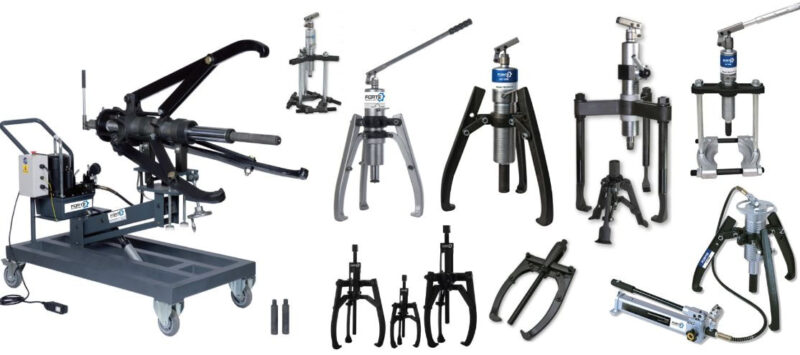
A hydraulic puller is a mechanical tool that uses a hydraulic system to create strong pulling or pushing force, helping to remove parts such as bearings, bushings, gears, pulleys, or couplings easily and safely. This tool has a load capacity from 4 tons to 100 tons, suitable for large or tightly fitted components in machinery disassembly systems. Hydraulic pullers are classified by:
- Number of jaws: 2-jaw, 3-jaw, or detachable 2-3 jaw models.
- Pump system: Integrated into the body or separate pump (manual, electric, pneumatic).
- Functions: Self-centering, mobile, heavy industrial.
At Naltako, hydraulic pullers are designed to integrate with equipment such as hydraulic pallet trucks or mini cranes, creating an effective industrial mechanical toolkit. For example, Naltako’s 3-jaw hydraulic puller with a 20-ton capacity can remove a 200 mm diameter bearing in minutes, reducing labor and increasing safety. The product is suitable for auto repair, shipbuilding, and machinery maintenance, ensuring evenly distributed pulling force and avoiding damage to parts.
Do you need a hydraulic puller for mechanical work? Contact us now at 0981.977.898 for Naltako to advise you on the right equipment!
>>> What is a 3-jaw puller? Some notes when using a 3-jaw puller
Structure and Principle of Hydraulic Pullers
A hydraulic puller consists of:
- Puller legs: 2 or 3 jaws, firmly clamping the part to be removed.
- Center bolt/spindle: Presses against the center of the bearing or machine shaft, transmitting the pulling force.
- Cylinder body: Contains the piston that creates force thanks to hydraulic oil pressure.
- Hydraulic pump system: Integrated or separate, creating a maximum pressure of 700 bar.
The operating principle is based on hydraulic oil pressure: the pump pushes oil into the cylinder, causing the piston to move, creating pulling or pushing force to remove the part. This design helps hydraulic pullers operate faster, safer, and more efficiently than traditional mechanical pullers, especially in machinery maintenance and repair equipment.
Choosing the Right Hydraulic Puller for the Component
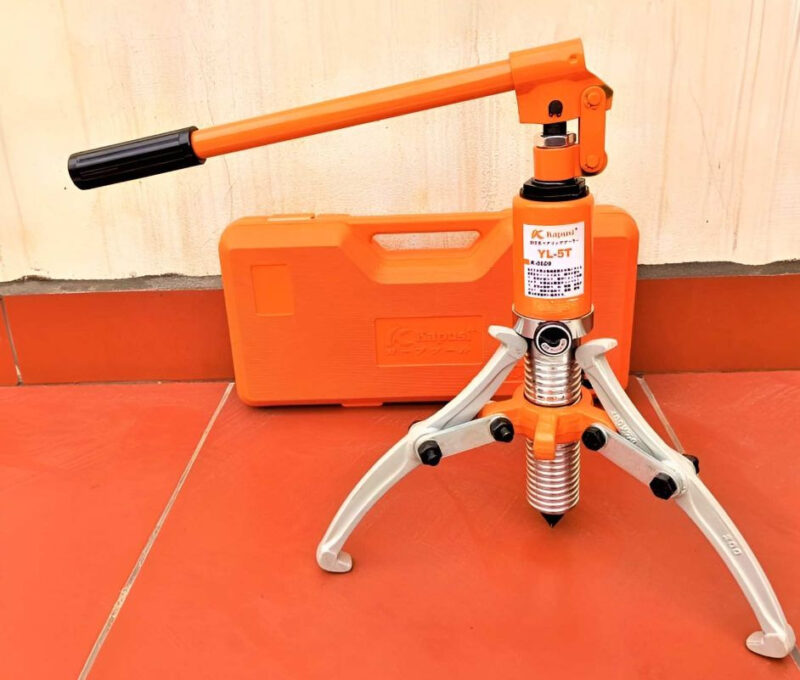
To choose a hydraulic puller suitable for the part to be removed, consider:
- Load capacity: Choose a puller with a capacity 2-3 times the part’s resistance (commonly 5-50 tons).
- Jaw spread/reach: Suitable for the part diameter, from 50 mm to 500 mm.
- Type of component: 3-jaw pullers for round bearings, 2-jaw pullers for narrow parts like pulleys.
Integrated vs. Separate Pump Hydraulic Pullers
Integrated pump hydraulic pullers and separate pump hydraulic pullers differ in design and usage:
- Integrated pullers: The hydraulic pump is built into the puller body, compact, easy to operate, suitable for small parts or tight spaces. The disadvantage is limited pulling force for very large components.
- Separate pump pullers: Use a separate manual, electric, or pneumatic pump, allowing for remote operation, increasing safety when removing heavy parts. The disadvantage is the need for hoses and a more complex setup.
Applications of Hydraulic Pullers in Industry
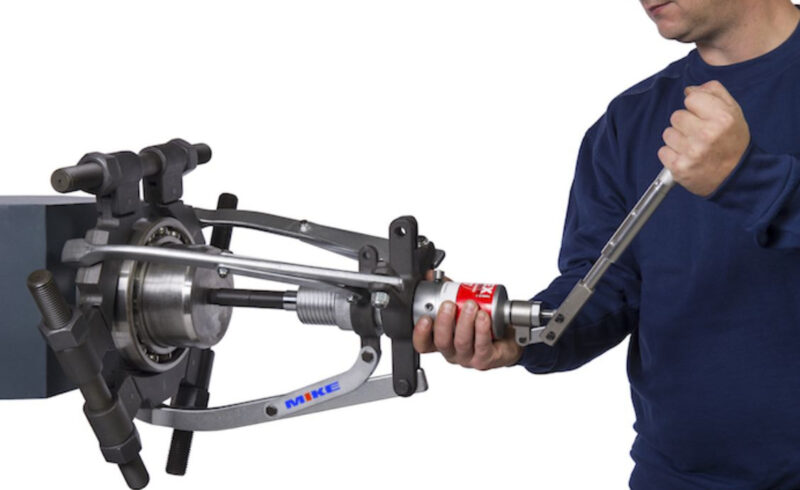
Hydraulic pullers are widely used in many fields:
- Automotive repair: Removing wheel hub bearings and bushings.
- Machinery maintenance: Removing gears and pulleys in production lines.
- Shipbuilding: Disassembling couplings and large components.
- Mechanical assembly: Positioning and removing parts in factories.
Naltako provides hydraulic pullers with evenly distributed pulling force, suitable for large parts and limited spaces in industrial mechanical toolsets. For example, Naltako’s mobile hydraulic puller with a 50-ton capacity, integrated wheels, and auxiliary outriggers, is ideal for removing railway wheel bearings. Combined with a tilt lift table, this tool helps increase efficiency and ensure safety in heavy industries.
Do you need a hydraulic puller for industrial applications? Contact us now at 0981.977.898 for Naltako to advise you on an effective solution!
Nội dung có liên quan:
-
 What is a Mechanical Dock Leveler? How does it differ from a Hydraulic Dock Leveler?
Are you looking for a device to support loading and unloading goods from containers to the warehouse floor that is low-cost, highly durable, and easy to in...
What is a Mechanical Dock Leveler? How does it differ from a Hydraulic Dock Leveler?
Are you looking for a device to support loading and unloading goods from containers to the warehouse floor that is low-cost, highly durable, and easy to in...
-
 Popular Types of Hydraulic Freight Elevators Today
The role of hydraulic freight elevators in warehouses, production workshops, or construction sites is indisputable. However, the types of hydraulic freight...
Popular Types of Hydraulic Freight Elevators Today
The role of hydraulic freight elevators in warehouses, production workshops, or construction sites is indisputable. However, the types of hydraulic freight...
-
 Safe Working Load in Industrial Lifting and Cargo Handling
In the modern industrial and logistics environment, lifting and cargo handling activities take place continuously with large volumes and high frequencies. ...
Safe Working Load in Industrial Lifting and Cargo Handling
In the modern industrial and logistics environment, lifting and cargo handling activities take place continuously with large volumes and high frequencies. ...
-
 The Differences Between Mechanical Dock Levelers and Hydraulic Dock Levelers
The difference between hydraulic dock levelers and mechanical dock levelers is very clear – Hydraulic dock levelers operate automatically with a push of a ...
The Differences Between Mechanical Dock Levelers and Hydraulic Dock Levelers
The difference between hydraulic dock levelers and mechanical dock levelers is very clear – Hydraulic dock levelers operate automatically with a push of a ...
-
 What Should You Consider When Buying a 700kg Hydraulic Lift Table?
The 700kg hydraulic lift table is a popular tool widely used in production workshops and warehouses. With a lifting capacity of 700kg, this hydraulic lift ...
What Should You Consider When Buying a 700kg Hydraulic Lift Table?
The 700kg hydraulic lift table is a popular tool widely used in production workshops and warehouses. With a lifting capacity of 700kg, this hydraulic lift ...
-
 When Should You Use a 1000kg Hydraulic Lift Table?
Are you running a business in a warehouse or workshop that isn't too large and feeling that work efficiency hasn't reached your expectations? Are you looki...
When Should You Use a 1000kg Hydraulic Lift Table?
Are you running a business in a warehouse or workshop that isn't too large and feeling that work efficiency hasn't reached your expectations? Are you looki...
-
 Advantages of 500kg Manual Lift Tables You Should Know
Are you looking to buy a medium-duty manual hydraulic lift table for home use? Is your work frequency intermittent, and are you looking for a product with ...
Advantages of 500kg Manual Lift Tables You Should Know
Are you looking to buy a medium-duty manual hydraulic lift table for home use? Is your work frequency intermittent, and are you looking for a product with ...
-
 A Guide to Choosing High-Quality Hydraulic Dock Levelers Today
Hydraulic Dock Levelers are among the essential support devices for many fields and industries. Thanks to this product, the transport and storage of goods ...
A Guide to Choosing High-Quality Hydraulic Dock Levelers Today
Hydraulic Dock Levelers are among the essential support devices for many fields and industries. Thanks to this product, the transport and storage of goods ...