

 Tiếng Việt
How to Calculate Forklift Ramp Load Capacity
In logistics and warehouse management operations, the forklift ramp plays a pivotal role, seamlessly connecting the warehouse floor with truck beds or containers. However, to ensure maximum safety for workers and lifting equipment, accurately calculating the forklift ramp load capacity is a mandatory requirement. Let’s explore how to calculate the forklift ramp load immediately so you can choose and design a safe, effective ramp that meets practical usage needs.
Why is it necessary to calculate forklift ramp load capacity?
Calculating the load capacity of a forklift ramp is extremely important as it directly affects operational safety, equipment lifespan, and work efficiency. Here are specific reasons:
Ensure safety for people and goods
If the load exceeds the ramp’s bearing capacity, the ramp may bend, break, or collapse, causing accidents. The forklift and operator could fall from a height, easily leading to injury or major damage.
Ensure ramp durability and lifespan
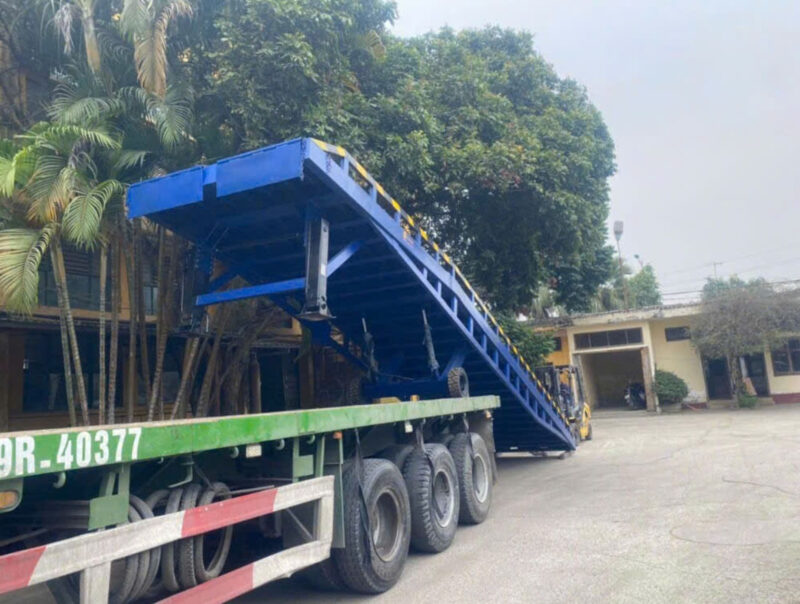
When operating within the correct load, the ramp is less prone to deformation, does not crack, and helps the equipment last longer.
Suitable for each type of forklift and cargo load
Hand pallet trucks, electric forklifts, or diesel forklifts have different weights and wheels, so careful calculation is needed to avoid damaging the ramp floor. The load includes not only the forklift but also the goods; incorrect calculation will pose potential risks.
Compliance with technical standards and inspection
Equipment such as ramps, lift tables, and lift ladders usually must meet TCVN or European standards. If the load design is incorrect, it will not be approved and will not qualify for operation in large factories and workshops.
Optimize investment costs
Accurate calculation helps you choose a ramp with a suitable structure, avoiding waste from excessive load capacity. At the same time, it also helps limit repair and maintenance costs due to overload damaging the equipment.
>>> Applications of forklift ramps at factories, warehouses, ports…
Formula for calculating forklift ramp load capacity
To determine the design load for a forklift ramp, the basic principle is that the ramp must withstand the maximum total weight that can pass over it at any one time. The simplest and most core formula is:
Ramp Load = Forklift Weight + Maximum Cargo Weight
Let’s analyze each component and related factors in detail:
Forklift Weight
This is the self-weight of the forklift that will be used to move across the ramp.
- Electric Forklift: Usually lighter, but still significant.
- Internal Combustion Forklift (Diesel/Gas): Usually heavier due to the engine and large counterweight.
- Important note: This weight is not fixed and varies by model, manufacturer, and the nominal lifting capacity of the forklift. Always check the exact technical specifications from your forklift manufacturer.
Maximum Cargo Weight

This is the heaviest weight of the package or pallet that the forklift can carry across the ramp.
- You need to determine the heaviest goods you frequently or potentially unload via the ramp.
- If the forklift can lift various loads, always calculate with the maximum load the forklift can carry according to the load chart, not the forklift’s nominal lifting capacity.
Illustrative Example
If you have:
- A diesel forklift with a self-weight of 4,500 kg.
- The forklift’s maximum lifting capacity is 3,000 kg and you frequently carry loads at this level.
Apply formula: Ramp Load = 4,500 kg (forklift) + 3,000 kg (goods) = 7,500 kg
Thus, you need a ramp capable of bearing a load of at least 7,500 kg (i.e., 7.5 tons).
>>> Safe working load in industrial lifting and cargo handling
Conclusion
Accurately calculating forklift ramp load capacity is a prerequisite step that cannot be ignored to ensure absolute safety and sustainable efficiency for all cargo handling operations. Never trade safety by skipping this critical calculation step. Always reach out to reputable suppliers like Naltako for in-depth advice, ensuring you possess a forklift ramp solution that not only meets load standards but also perfectly fits your specific needs.
Nội dung có liên quan:
-
 What is a Mechanical Dock Leveler? How does it differ from a Hydraulic Dock Leveler?
Are you looking for a device to support loading and unloading goods from containers to the warehouse floor that is low-cost, highly durable, and easy to in...
What is a Mechanical Dock Leveler? How does it differ from a Hydraulic Dock Leveler?
Are you looking for a device to support loading and unloading goods from containers to the warehouse floor that is low-cost, highly durable, and easy to in...
-
 Popular Types of Hydraulic Freight Elevators Today
The role of hydraulic freight elevators in warehouses, production workshops, or construction sites is indisputable. However, the types of hydraulic freight...
Popular Types of Hydraulic Freight Elevators Today
The role of hydraulic freight elevators in warehouses, production workshops, or construction sites is indisputable. However, the types of hydraulic freight...
-
 Safe Working Load in Industrial Lifting and Cargo Handling
In the modern industrial and logistics environment, lifting and cargo handling activities take place continuously with large volumes and high frequencies. ...
Safe Working Load in Industrial Lifting and Cargo Handling
In the modern industrial and logistics environment, lifting and cargo handling activities take place continuously with large volumes and high frequencies. ...
-
 The Differences Between Mechanical Dock Levelers and Hydraulic Dock Levelers
The difference between hydraulic dock levelers and mechanical dock levelers is very clear – Hydraulic dock levelers operate automatically with a push of a ...
The Differences Between Mechanical Dock Levelers and Hydraulic Dock Levelers
The difference between hydraulic dock levelers and mechanical dock levelers is very clear – Hydraulic dock levelers operate automatically with a push of a ...
-
 What Should You Consider When Buying a 700kg Hydraulic Lift Table?
The 700kg hydraulic lift table is a popular tool widely used in production workshops and warehouses. With a lifting capacity of 700kg, this hydraulic lift ...
What Should You Consider When Buying a 700kg Hydraulic Lift Table?
The 700kg hydraulic lift table is a popular tool widely used in production workshops and warehouses. With a lifting capacity of 700kg, this hydraulic lift ...
-
 When Should You Use a 1000kg Hydraulic Lift Table?
Are you running a business in a warehouse or workshop that isn't too large and feeling that work efficiency hasn't reached your expectations? Are you looki...
When Should You Use a 1000kg Hydraulic Lift Table?
Are you running a business in a warehouse or workshop that isn't too large and feeling that work efficiency hasn't reached your expectations? Are you looki...
-
 Advantages of 500kg Manual Lift Tables You Should Know
Are you looking to buy a medium-duty manual hydraulic lift table for home use? Is your work frequency intermittent, and are you looking for a product with ...
Advantages of 500kg Manual Lift Tables You Should Know
Are you looking to buy a medium-duty manual hydraulic lift table for home use? Is your work frequency intermittent, and are you looking for a product with ...
-
 A Guide to Choosing High-Quality Hydraulic Dock Levelers Today
Hydraulic Dock Levelers are among the essential support devices for many fields and industries. Thanks to this product, the transport and storage of goods ...
A Guide to Choosing High-Quality Hydraulic Dock Levelers Today
Hydraulic Dock Levelers are among the essential support devices for many fields and industries. Thanks to this product, the transport and storage of goods ...